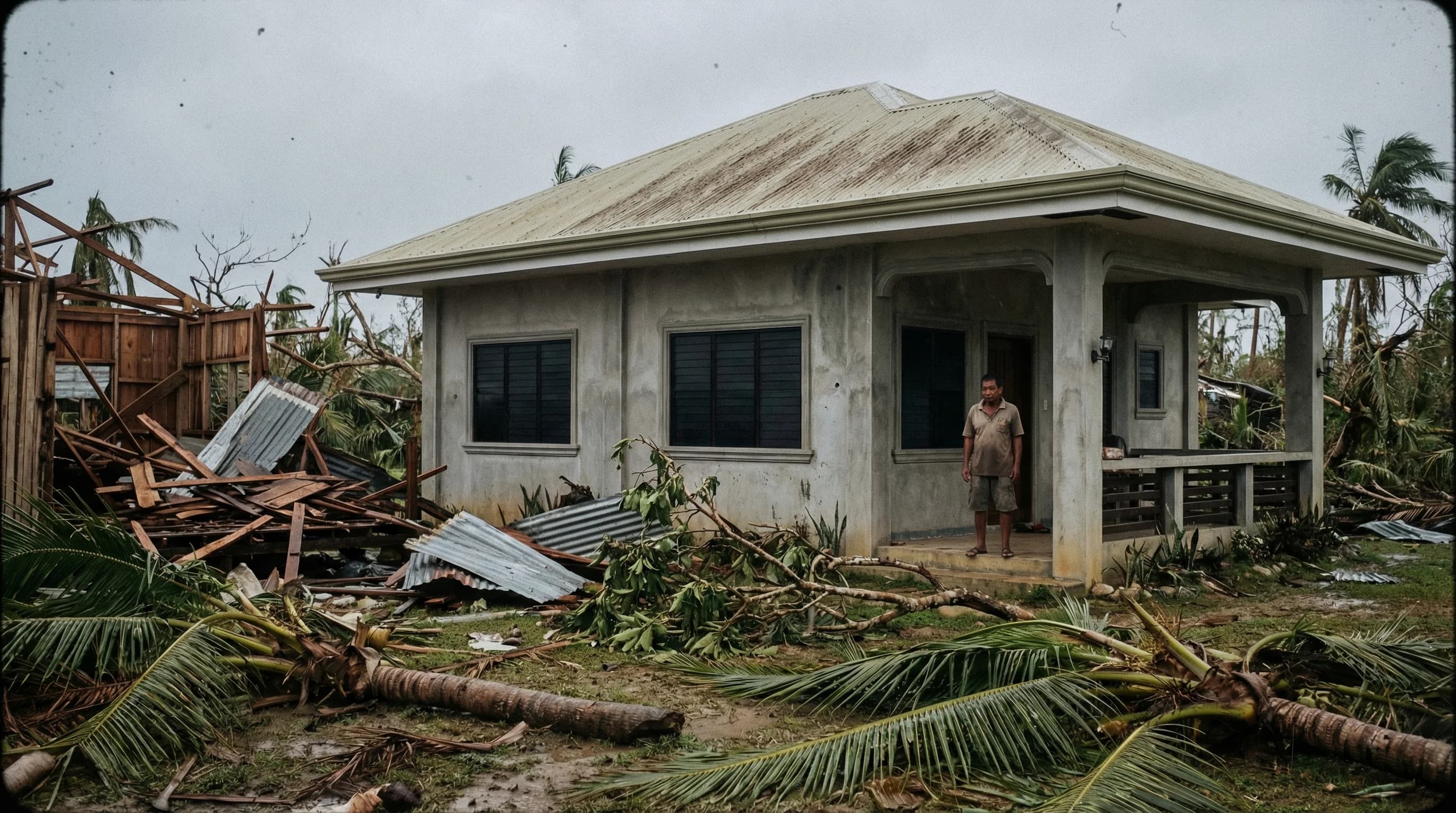
Super Typhoon Odette (international name: Rai) hit Siargao on December 16, 2021, with sustained winds of 195 km/h and gusts over 260 km/h. It destroyed roughly 80% of structures on the island. The villas that survived shared three things: reinforced concrete frames, properly anchored roofs, and hip roof designs instead of gable ends.
What Odette Taught Us About Building on Siargao
Siargao sits in the Philippine typhoon corridor. Between 2010 and 2025, the Caraga region (which includes Surigao del Norte) was hit by at least 8 significant typhoons. Odette was the worst, but it won't be the last.
Here's what survived and what didn't:
| Structure Type | Survival Rate | Why |
|---|---|---|
| Reinforced concrete with hip roof | High | Wind flows over hip roofs. Concrete frame holds. |
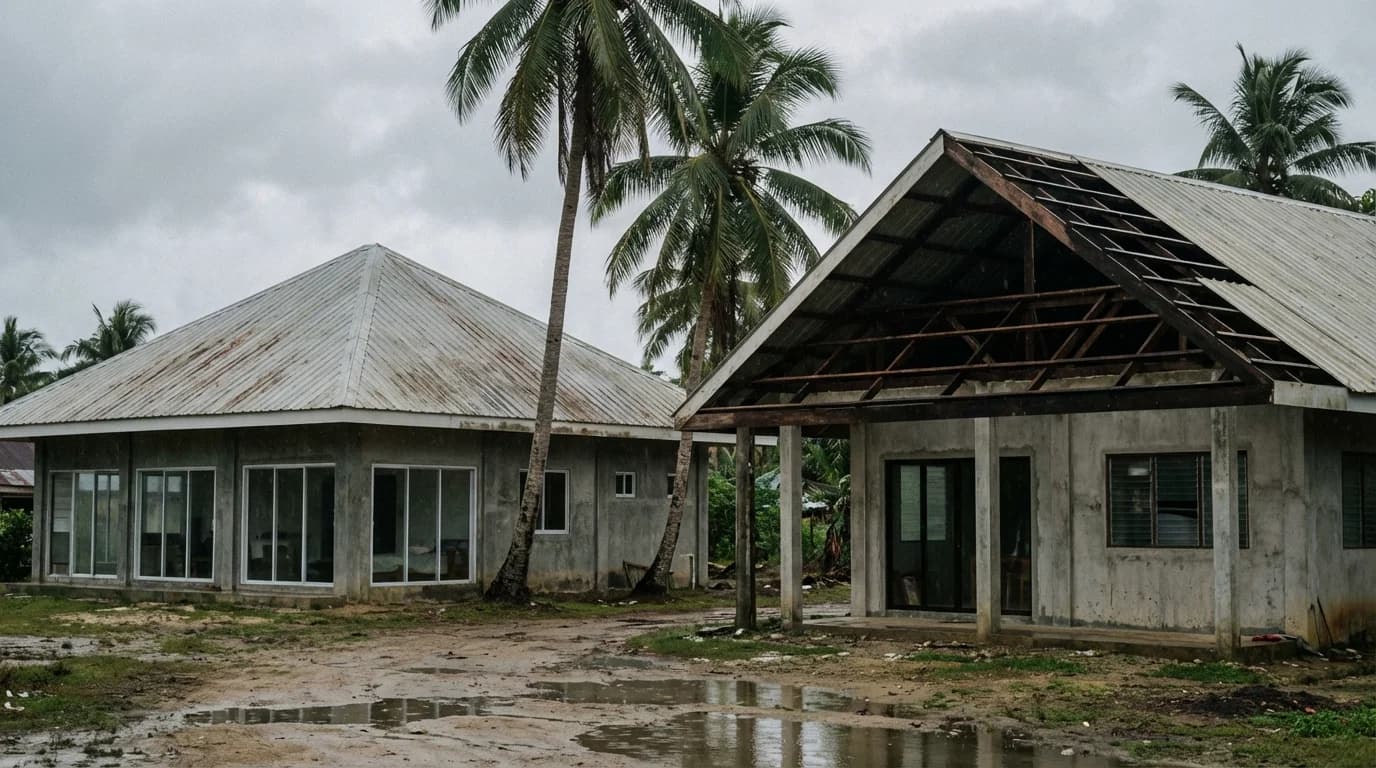
| Concrete walls with metal gable roof | Mixed | Gable ends catch wind like a sail. Roofs ripped off even on solid walls. |
| Wood frame with nipa/cogon roof | Very low | No structural resistance above 120 km/h. |
| Concrete with flat roof | Moderate | Survives wind but vulnerable to water pooling and leaks. |
| Shipping containers | Moderate | Withstand wind but overheat, rust fast in salt air. |
The pattern is clear: the roof is the weak point, not the walls. Most concrete walls stood through Odette. But roofs that weren't properly tied down got peeled off, and everything inside was destroyed by rain.
Structural Design for Typhoon Resistance
The Philippine National Building Code (NBC) and National Structural Code of the Philippines (NSCP) classify Siargao as Wind Zone 2, requiring structures to withstand minimum wind speeds of 200 km/h. After Odette, many builders on the island now design for 250 km/h or higher.
Roof Design
Your roof shape is the single most important design decision for typhoon resistance.
| Roof Type | Wind Resistance | Cost Impact | Recommendation |
|---|---|---|---|
| Hip roof (4 slopes) | Excellent | +5-8% vs gable | Best choice for Siargao |
| Modified hip | Very good | +3-5% vs gable | Good compromise |
| Gable roof (2 slopes) | Poor to moderate | Baseline | Avoid on exposed sites |
| Flat roof | Moderate | Varies | Risk of water ponding |
Hip roofs slope on all four sides, so wind flows over them without catching a flat surface. A 25 to 30-degree pitch gives the best balance between wind resistance and rain shedding.
Roof Anchoring
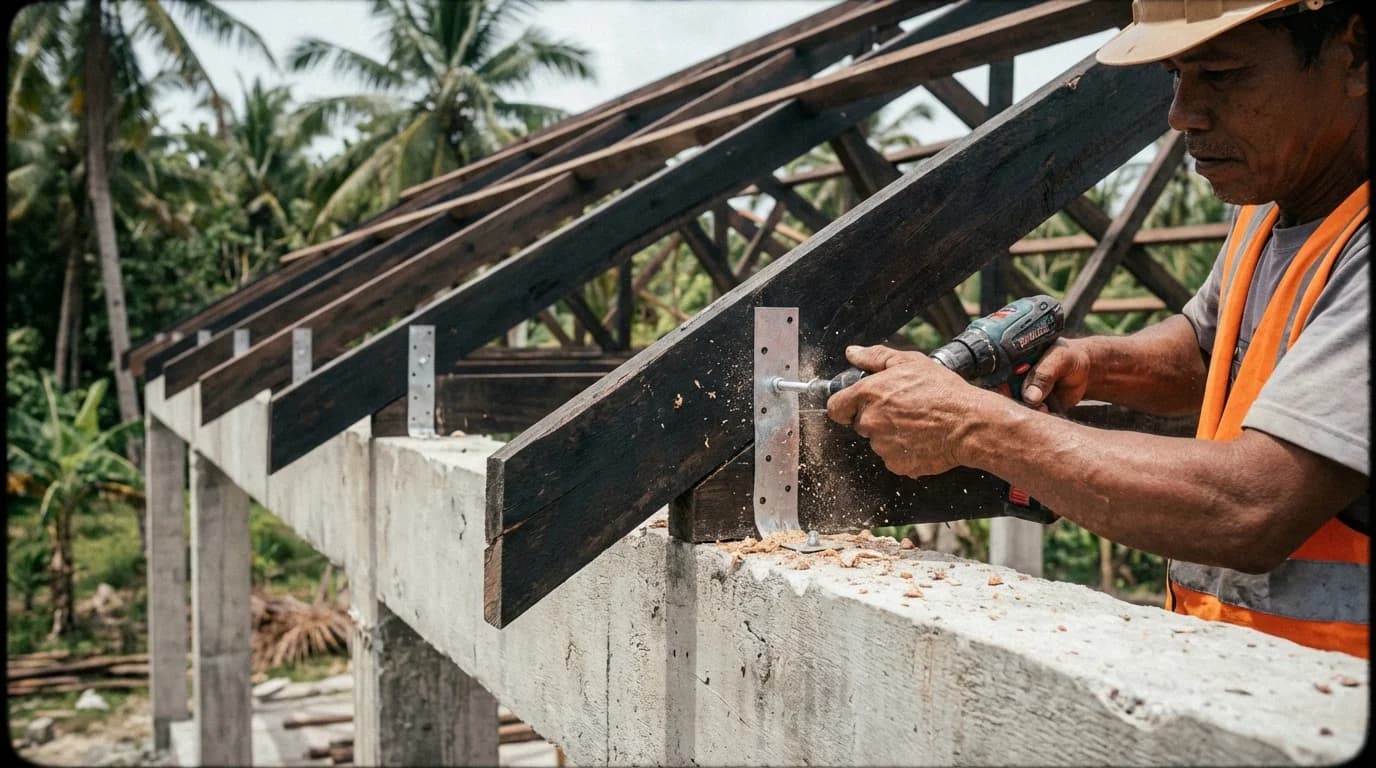
The roof doesn't just sit on the walls. It needs to be mechanically tied down with a continuous load path from the foundation through the walls to the roof.
Hurricane straps (also called typhoon clips or Simpson Strong-Ties) connect each rafter or truss to the top plate or ring beam. They cost ₱80 to ₱150 per strap, and a typical 120 sqm villa needs 40 to 60 of them. That's ₱5,000 to ₱9,000 in materials for the difference between keeping or losing your roof.
| Anchoring Component | Purpose | Cost Estimate |
|---|---|---|
| Hurricane straps (40-60 pcs) | Tie rafters to ring beam | ₱5,000 to ₱9,000 |
| Ring beam (continuous) | Distribute roof loads to walls | Included in structural design |
| Tie beams at lintel level | Prevent wall separation | Included in structural design |
| J-bolts in foundation | Anchor posts to concrete | ₱3,000 to ₱5,000 |
Roofing Material
For Siargao, use corrugated metal roofing with a minimum gauge of 0.4mm (Gauge 26). Thicker is better: 0.5mm (Gauge 24) resists denting and wind uplift much better. Pre-painted galvalume lasts longer than plain GI in the salt air environment.
Screw spacing matters: Use self-drilling tek screws at 200mm intervals on purlins, not 300mm. On ridge caps and eaves, go tighter at 150mm. Every screw that's missing is a potential entry point for wind.
Structural Frame Requirements
Columns and Beams
A typhoon-resistant structure needs proper reinforced concrete framing. Here's what that looks like in practice:
| Element | Minimum Spec | Typhoon-Rated Spec |
|---|---|---|
| Column size | 200mm x 200mm | 250mm x 250mm (or 250mm diameter) |
| Column rebar | 4 x 12mm bars | 6 x 16mm bars with 10mm ties at 150mm spacing |
| Beam size | 200mm x 300mm | 250mm x 400mm |
| Beam rebar | 4 x 12mm | 6 x 16mm top/bottom |
| Concrete mix | 3000 PSI | 4000 PSI (28-day strength) |
The difference between "minimum code" and "typhoon-rated" adds roughly 10 to 15% to your structural costs. On a Standard quality 120 sqm villa (base cost around ₱4.3M), that's an extra ₱430,000 to ₱645,000.
Walls
Concrete hollow blocks (CHB) are the standard wall material on Siargao. Use 6-inch (150mm) CHB for exterior walls, not 4-inch. Fill every third cell with grout and rebar at minimum. For typhoon-rated construction, fill every other cell.
The wall-to-column connection is critical. Walls must be tied into columns with horizontal rebar (dowels) every 600mm vertically. Without these connections, walls can blow out between columns like panels.
Foundation
A continuous strip foundation with tied footings resists both wind uplift and lateral forces. Column footings should be a minimum of 600mm x 600mm x 300mm deep, with rebar extending into the column above.
What Typhoon-Proofing Costs
Here's a realistic cost breakdown comparing standard and typhoon-rated construction for a 120 sqm, 2-bedroom villa:
| Item | Standard Build | Typhoon-Rated | Difference |
|---|---|---|---|
| Structural frame (columns, beams) | ₱850,000 | ₱990,000 | +₱140,000 |
| Roofing (material + labor) | ₱280,000 | ₱340,000 | +₱60,000 |
| Hurricane straps + anchoring | ₱0 | ₱15,000 | +₱15,000 |
| Wall reinforcement (extra grout/rebar) | ₱120,000 | ₱155,000 | +₱35,000 |
| Higher-grade concrete (4000 PSI) | Included | +₱45,000 | +₱45,000 |
| Hip roof premium | ₱0 | ₱50,000 | +₱50,000 |
| Total structural | ₱1,250,000 | ₱1,595,000 | +₱345,000 |
That's roughly a 12% premium on structural costs, or about 8% on total build cost. Compare that to the cost of rebuilding after a typhoon (100% of build cost plus months of lost rental income), and it's not even a question.
Insurance for Siargao Properties
Property insurance in the Philippines covers fire, typhoon, earthquake, and flood damage. Here's what you need to know:
| Coverage Type | Annual Premium (typical) | Notes |
|---|---|---|
| Fire insurance | 0.15-0.25% of property value | Required by most lenders |
| Typhoon/windstorm | 0.20-0.40% of property value | Often bundled with fire |
| Earthquake | 0.10-0.15% of property value | Separate rider |
| Flood | 0.10-0.20% of property value | Important for coastal/low-lying |
| Comprehensive (all perils) | 0.50-0.80% of property value | Best value for Siargao |
For a ₱5M villa, comprehensive insurance runs ₱25,000 to ₱40,000 per year. That's roughly ₱2,000 to ₱3,300 per month.
Important: Insurers inspect properties before issuing policies. A typhoon-rated structure with documented engineering plans typically qualifies for 20 to 40% lower premiums than a structure without engineering certifications. That premium discount alone can offset most of the typhoon-proofing cost over 10 years.
Major providers active in the Visayas and Mindanao include Pioneer Insurance, Malayan Insurance, and GSIS (government). Get quotes from at least two before committing.
Backup Systems: Power and Water After a Typhoon
Typhoons knock out SIARELCO power for days to weeks. Odette left parts of Siargao without electricity for over three months. Your villa needs backup systems:
| System | Purpose | Cost Range |
|---|---|---|
| Generator (5-10 kVA) | Immediate backup power | ₱80,000 to ₱250,000 |
| Solar + battery | Long-term off-grid capability | ₱550,000 to ₱1,100,000 |
| Water storage tank (1,000-2,000L) | Bridging supply disruptions | ₱15,000 to ₱35,000 |
| Deep well | Independent water source | ₱90,000 to ₱195,000 |
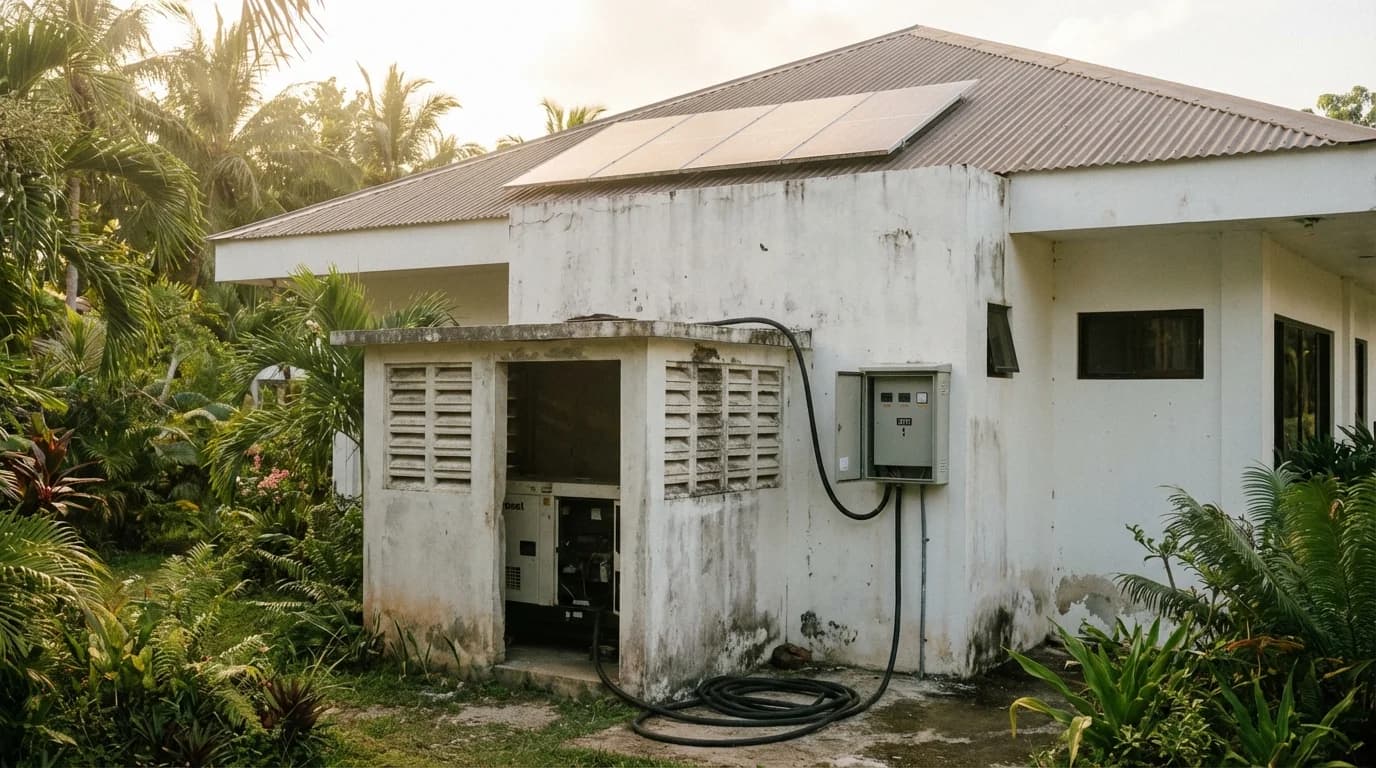
A generator with an automatic transfer switch (ATS) is the minimum. If you're running an Airbnb, guests expect uninterrupted power. A solar and battery system with generator backup is the gold standard for Siargao. For more details, see our complete guide to off-grid infrastructure and solar power costs on Siargao.
The Typhoon-Proofing Checklist
Before your build starts, make sure your builder commits to these items in writing:
- Hip roof or modified hip with 25-30 degree pitch
- Hurricane straps on every rafter-to-beam connection
- Ring beam continuous around the top of all walls
- Minimum 250mm columns with 16mm rebar and 150mm tie spacing
- 4000 PSI concrete for all structural elements
- 0.4mm minimum roof gauge (0.5mm preferred) with 200mm screw spacing
- 6-inch CHB for exterior walls with grouted cells
- Rebar dowels connecting walls to columns every 600mm
- Lap splices at 40x bar diameter minimum
- ATS generator connection pre-wired during electrical rough-in
Print this list and have your builder sign off on each item. If they resist, that tells you something.
Frequently Asked Questions
How much extra does typhoon-proof construction cost on Siargao?
Expect a 10 to 15% premium on structural costs, which translates to roughly 8 to 10% on total build cost. For a typical 120 sqm Standard villa, that's an extra ₱345,000 to ₱500,000. The investment pays for itself through lower insurance premiums and, more importantly, not having to rebuild.
Can a cottage or wooden structure survive a super typhoon?
Unlikely above 150 km/h sustained winds. Odette hit at 195 km/h, and almost no lightweight structures survived intact. If you're building a cottage-tier property, at minimum use reinforced concrete columns with a properly anchored metal roof. See our villa construction cost breakdown for how quality tiers compare.
Is typhoon insurance mandatory on Siargao?
Not legally required unless you have a mortgage. But skipping it is a gamble. Comprehensive coverage for a ₱5M villa costs ₱25,000 to ₱40,000 per year. That's less than one week of Airbnb revenue for most 2-bedroom villas. Check our Airbnb income analysis for typical rental numbers.
What roofing material is best for typhoons?
Pre-painted galvalume corrugated sheets in Gauge 24 (0.5mm) or Gauge 26 (0.4mm). Avoid thinner gauges. The key isn't just the material but how it's fastened: tek screws at 200mm spacing, with closer spacing at eaves and ridges. Nipa and cogon roofing won't survive anything above a tropical storm.
When is typhoon season on Siargao?
June through November, with September and October being the highest-risk months. But Odette hit in December, proving that "season" is a guideline, not a guarantee. Read our month-by-month construction timing guide for planning your build around the weather.
Use our cost calculator to see how typhoon-resistant specs affect your total build budget, and check the complete cost guide for a full breakdown of what goes into a Siargao villa.
