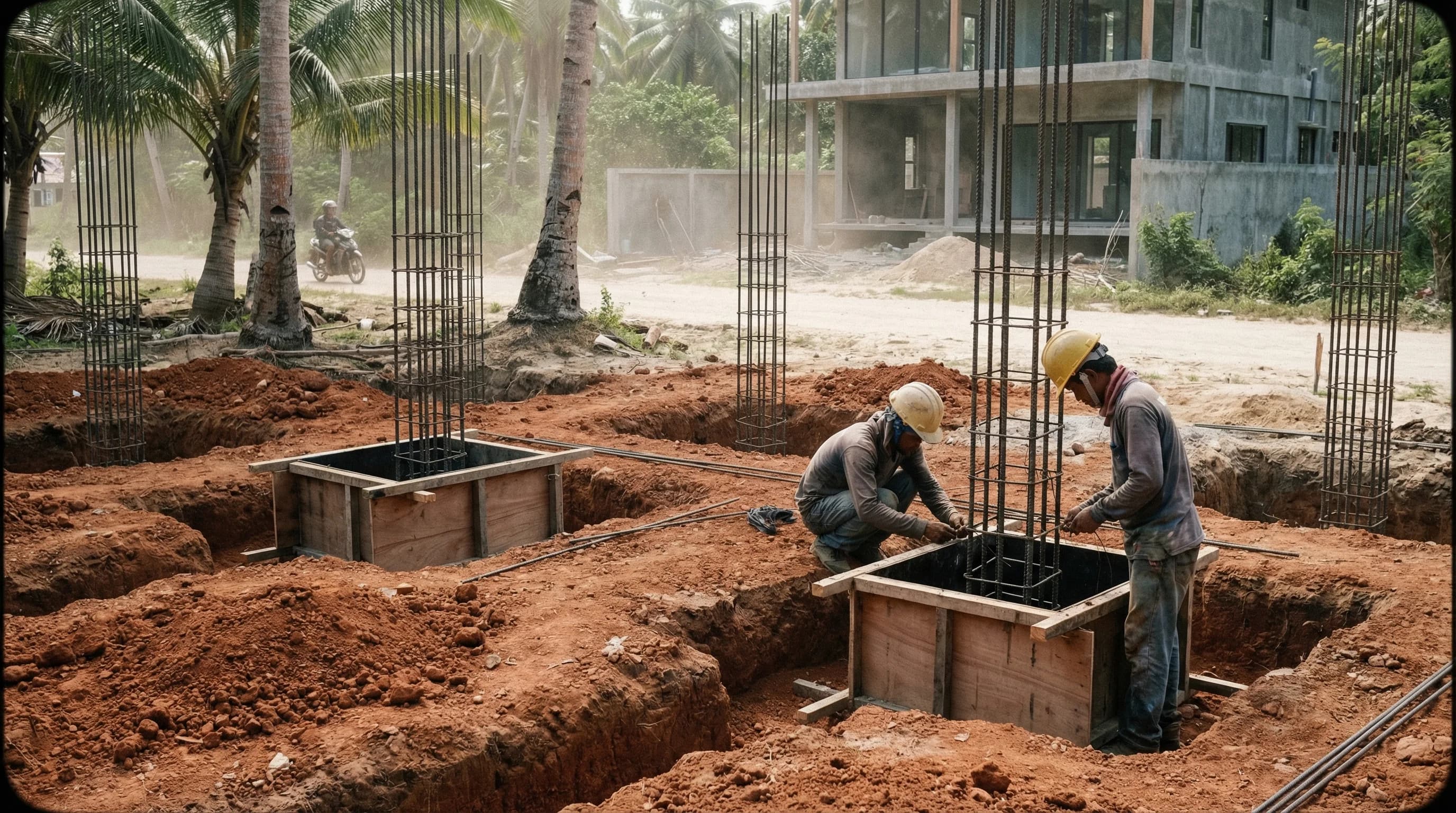
Siargao sits on the Philippine Mobile Belt, one of the most seismically active zones on the planet. The Philippines records an average of 20 earthquakes per day, most too small to feel. But Surigao del Norte, the province Siargao belongs to, was hit by a magnitude 6.7 earthquake on February 10, 2017, killing 8 people and damaging over 5,000 structures on the mainland. The epicenter was just 18 km from Surigao City, the ferry gateway to Siargao.
Why Siargao Has Earthquake Risk
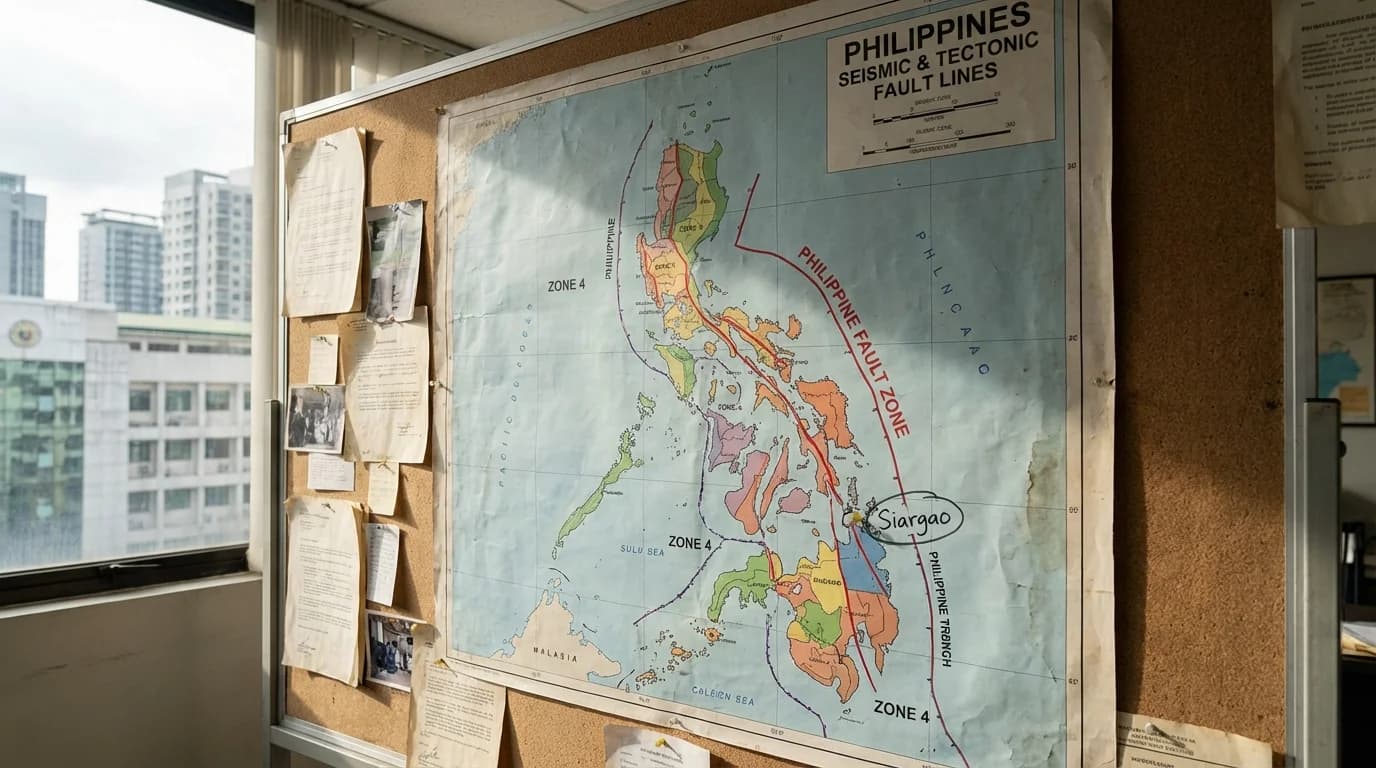
The Philippines sits at the convergence of two major tectonic plates: the Philippine Sea Plate and the Eurasian Plate. This makes the entire archipelago part of the Pacific Ring of Fire. Mindanao, where Siargao is located, has multiple active fault systems including the Philippine Fault Zone that runs through the eastern side of the island chain.
The Philippine Institute of Volcanology and Seismology (PHIVOLCS) classifies Surigao del Norte in Seismic Zone 4, the highest classification. This means structures must be designed for the maximum seismic ground acceleration values in the building code.
| Seismic Zone | Ground Acceleration | Risk Level | Areas |
|---|---|---|---|
| Zone 2 | 0.20g to 0.30g | Moderate | Parts of Visayas |
| Zone 3 | 0.30g to 0.40g | High | Central Mindanao |
| Zone 4 | 0.40g+ | Very High | Eastern Mindanao, including Siargao |
The difference between Zone 2 and Zone 4 isn't academic. Zone 4 requires roughly 30 to 40% more structural reinforcement in the design.
The National Structural Code (NSCP) Requirements
The National Structural Code of the Philippines (NSCP 2015, Volume 1) sets mandatory seismic design requirements for all new construction. On Siargao, your structural engineer should design according to these minimum parameters:
| Parameter | NSCP Requirement for Siargao |
|---|---|
| Seismic Zone | Zone 4 |
| Soil Profile Type | SD or SE (soft/coastal soils typical) |
| Importance Factor | 1.0 (residential), 1.25 (essential facilities) |
| Seismic Response Coefficient | Calculated per NSCP Section 208 |
| Minimum rebar grade | Grade 40 (275 MPa) or Grade 60 (415 MPa) |
For a typical 2-story residential villa, the practical impact of Zone 4 classification means larger footings, more rebar, closer tie spacing in columns, and proper lap splice lengths.
Foundation Design for Siargao Soils
Siargao's coastal areas have sandy and coral-based soils that behave unpredictably during earthquakes. The two biggest risks are settlement (soil compresses under load) and liquefaction (saturated sandy soil loses its bearing strength during shaking and behaves like liquid).
Soil Types on Siargao
| Location Type | Typical Soil | Seismic Risk | Foundation Approach |
|---|---|---|---|
| Beachfront | Sandy, coral rubble | Liquefaction possible | Deep footings, compacted fill, or piles |
| Inland (General Luna, Tourism Road) | Clay/loam over coral | Moderate settlement | Standard strip foundation with tied footings |
| Hillside (parts of Cloud 9) | Rocky coral limestone | Low | Anchored directly to rock |
| Low-lying (Dapa, mangrove areas) | Soft clay, high water table | High settlement + liquefaction | Pile foundation recommended |
Foundation Specifications
For most Siargao sites, a reinforced concrete strip foundation with tied column footings works well. Here are the minimum specs for seismic Zone 4:
| Foundation Element | Standard Spec | Seismic Zone 4 Spec |
|---|---|---|
| Column footing size | 600mm x 600mm | 800mm x 800mm |
| Footing depth | 250mm | 300mm minimum |
| Footing rebar | 12mm bars at 200mm spacing, both ways | 12mm bars at 150mm spacing, both ways |
| Strip foundation width | 300mm | 400mm |
| Strip foundation depth | 250mm | 300mm |
| Grade beam rebar | 4 x 12mm bars | 4 x 16mm bars |
The cost difference between standard and seismic-rated foundations is modest: roughly ₱40,000 to ₱80,000 for a 120 sqm villa. Most of the extra cost is rebar and concrete volume.
Column and Beam Design for Seismic Loads
Columns and beams are where earthquake resistance lives or dies. During an earthquake, the structure sways laterally. Columns resist this movement, and beam-to-column joints transfer the forces. A failure at any joint can cause progressive collapse.
Critical Details
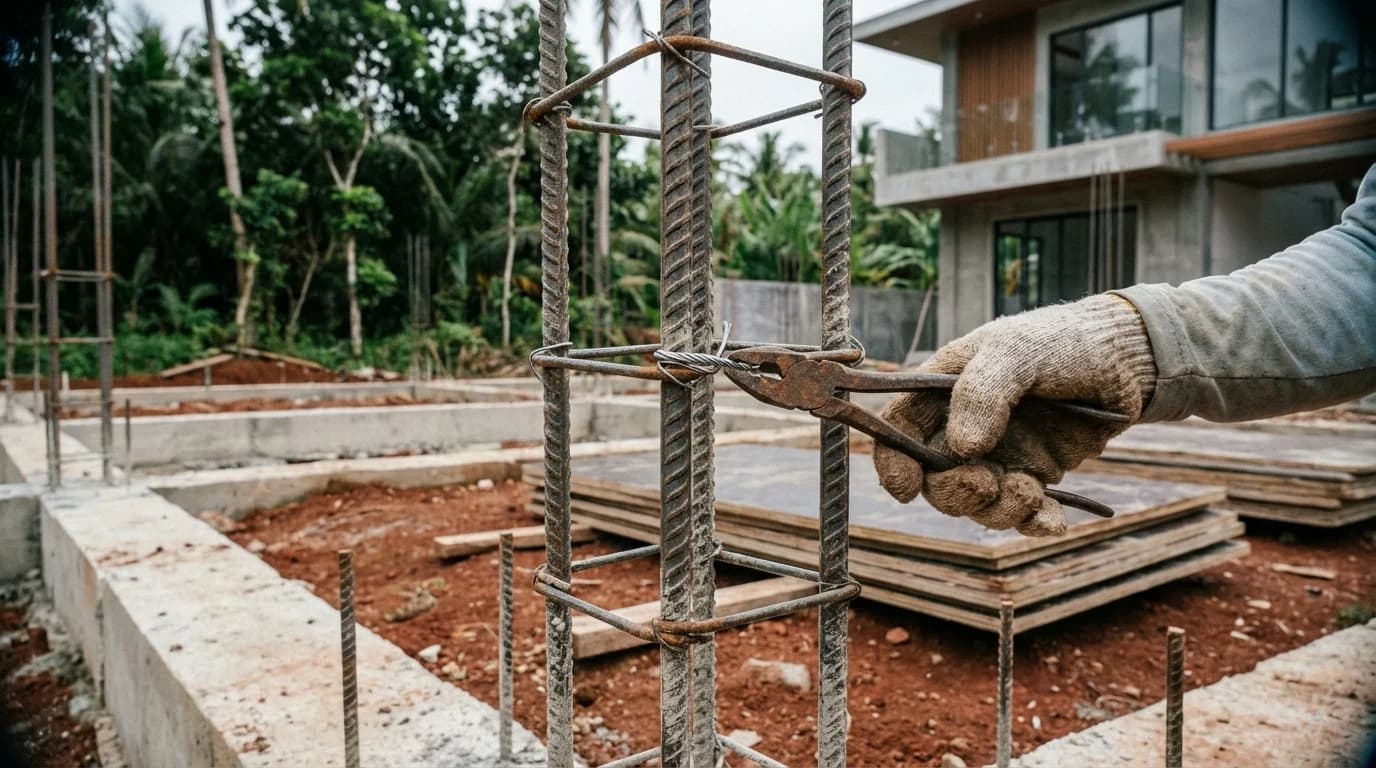
Column tie spacing is the most commonly shortcut item on Siargao builds. The NSCP requires ties (horizontal hoops around the vertical rebar) at maximum 150mm spacing within the "confinement zone," which is the top and bottom 500mm of each column where it meets beams and footings. In between, spacing can relax to 200mm.
Many builders on Siargao use 300mm spacing throughout, which is not code-compliant for Zone 4. This is easy to inspect during construction: just count the ties.
| Column Spec | Non-Seismic | Seismic Zone 4 |
|---|---|---|
| Minimum column size | 200mm x 200mm | 250mm x 250mm |
| Vertical rebar | 4 x 12mm | 6 x 16mm |
| Tie spacing (confinement zone) | 200mm | 100-150mm |
| Tie spacing (mid-height) | 250mm | 200mm |
| Tie bar diameter | 8mm | 10mm |
| Concrete strength | 3000 PSI | 3500-4000 PSI |
The Soft-Story Problem
If you're building two or three stories, watch out for "soft story" design. This happens when the ground floor has open areas (like carports, open living areas, or commercial space) while upper floors have full walls. The ground floor becomes the weak point and can collapse sideways during an earthquake.
To avoid this:
- Add shear walls on the ground floor (at least 2 per direction)
- Use larger columns on the ground floor than upper floors
- Don't remove or reduce walls on the ground floor for "open plan" aesthetics without compensating with structural elements
Combined Typhoon and Earthquake Design
Siargao is one of the few places where your structure needs to resist both high-wind and high-seismic loads simultaneously. The good news: many of the requirements overlap.
| Design Element | Typhoon Benefit | Earthquake Benefit | Double Win? |
|---|---|---|---|
| Larger columns (250mm+) | Better wind resistance | Better lateral resistance | Yes |
| 4000 PSI concrete | Stronger connections | Higher shear capacity | Yes |
| Continuous ring beam | Anchors roof to walls | Distributes seismic forces | Yes |
| Tied footings | Resists uplift | Resists overturning | Yes |
| Wall dowels to columns | Prevents blow-out | Prevents separation | Yes |
| Hip roof | Wind deflection | Lighter than gable (less seismic mass) | Yes |
| Closer tie spacing | Better ductility | Better ductility | Yes |
Most of the typhoon-proofing upgrades we describe in our typhoon-proof building guide also improve earthquake performance. If you're designing for one, you're already halfway to the other.
What Seismic-Rated Construction Costs Extra
The premium for earthquake-resistant design on Siargao is smaller than typhoon-proofing because much of the cost is in engineering, not materials:
| Item | Standard | Seismic Zone 4 | Difference |
|---|---|---|---|
| Structural engineering fee | ₱50,000 | ₱80,000 | +₱30,000 |
| Foundation (extra rebar/concrete) | Included | +₱60,000 | +₱60,000 |
| Column upgrades (rebar + ties) | Included | +₱45,000 | +₱45,000 |
| Higher-grade concrete | Included | +₱25,000 | +₱25,000 |
| Soil testing (optional but recommended) | ₱0 | ₱15,000-25,000 | +₱20,000 |
| Total | +₱180,000 |
For a ₱4.3M Standard villa, that's about a 4% premium. Combined with typhoon-proofing (another 8%), you're looking at a total structural upgrade of roughly 12% above baseline. That puts your total build firmly in the "built to last" category.
Frequently Asked Questions
How likely is an earthquake on Siargao?
Very likely over the life of your building. The Philippines averages 20 earthquakes per day, and Surigao del Norte is classified as Seismic Zone 4 (highest risk). The 2017 magnitude 6.7 earthquake near Surigao City caused significant damage just 18 km from the ferry port to Siargao. A similar event could happen again.
Does the Philippine building code require earthquake-resistant design?
Yes. The NSCP 2015 mandates seismic design for all new structures. For Siargao (Zone 4), this means the most stringent requirements in the code. However, enforcement varies. Make sure your structural engineer provides NSCP-compliant calculations, not just drawings.
Should I get soil testing done before building?
For beachfront or low-lying properties, absolutely. A soil bearing test costs ₱15,000 to ₱25,000 and tells your engineer exactly what kind of foundation you need. For inland rocky sites, it's less critical but still good practice. Your structural engineer can advise based on the location.
Can a one-story cottage skip seismic design?
Legally, no. Practically, a single-story concrete cottage has inherent earthquake resistance due to its low center of gravity and small mass. But you should still follow minimum code requirements for rebar, tie spacing, and foundation size. The cost difference is minimal for a small structure.
Does earthquake insurance exist in the Philippines?
Yes. Most comprehensive property insurance policies include earthquake coverage as a rider. Typical premiums are 0.10 to 0.15% of property value per year (₱5,000 to ₱7,500 for a ₱5M villa). It's often bundled with typhoon and fire coverage in an "all perils" policy. See our typhoon-proof building guide for insurance details.
Use our cost calculator to estimate your total build cost including structural upgrades, and check the complete cost guide for a detailed breakdown of all cost components.
