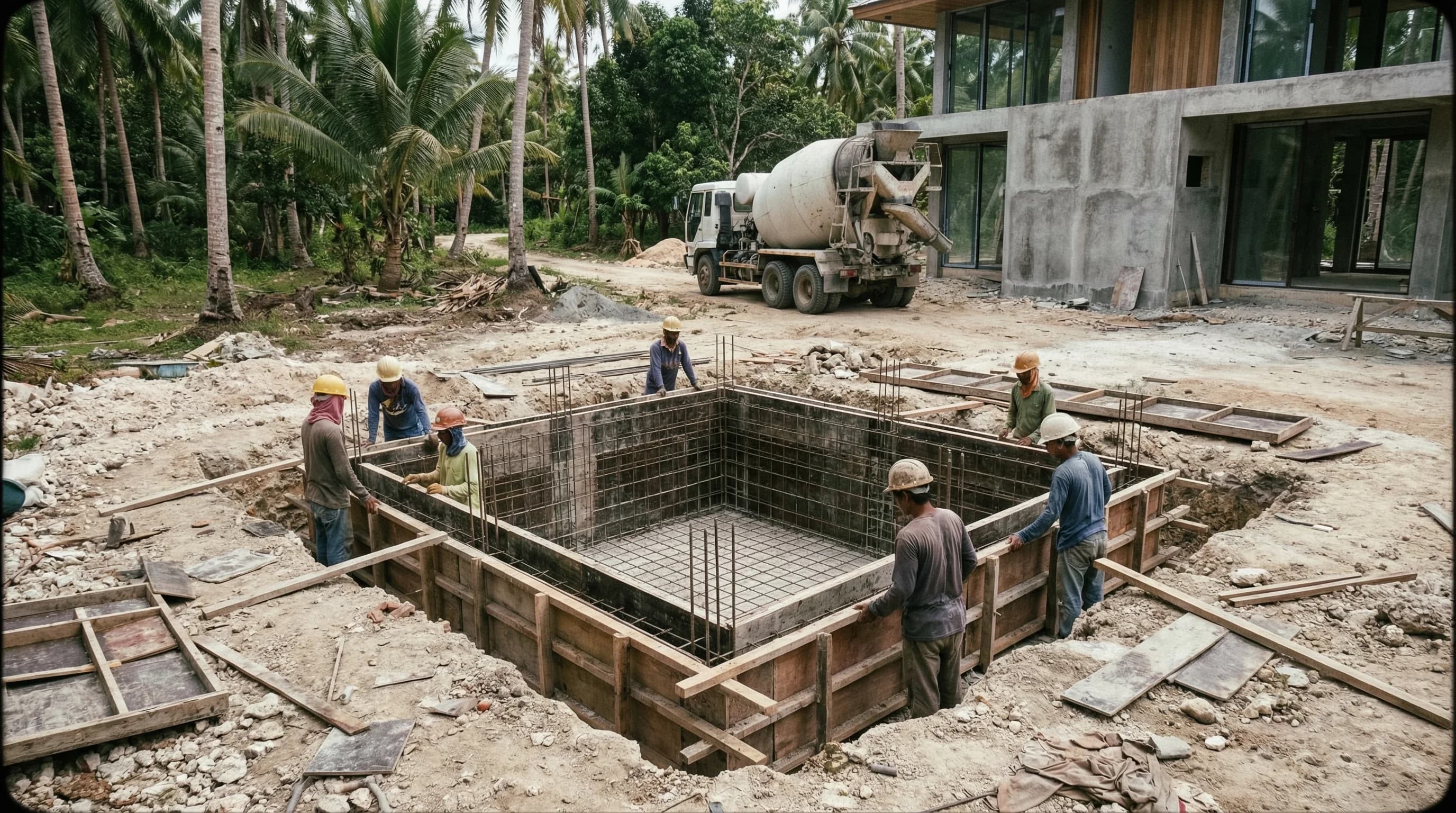
Two types of septic tanks get built on Siargao: standard concrete hollow block (CHB) and high-quality poured concrete. That's it. No bio-septic, no fancy imported systems. Local contractors know these two methods, and local material supply chains support them.
The price gap between them is ₱30,000. The performance gap is bigger than the price suggests. Here's how they compare and when to pick which one.
Standard CHB vs High-Quality Poured Concrete
A standard septic tank uses concrete hollow blocks (CHB) stacked and mortared into a multi-chamber tank. It's the same material used for most walls on the island. The blocks are cheap, locally available, and every mason knows how to work with them. The problem: CHB joints are the weak point. Over time, the mortar cracks. Wastewater seeps through the block walls into the surrounding soil before it's properly treated.
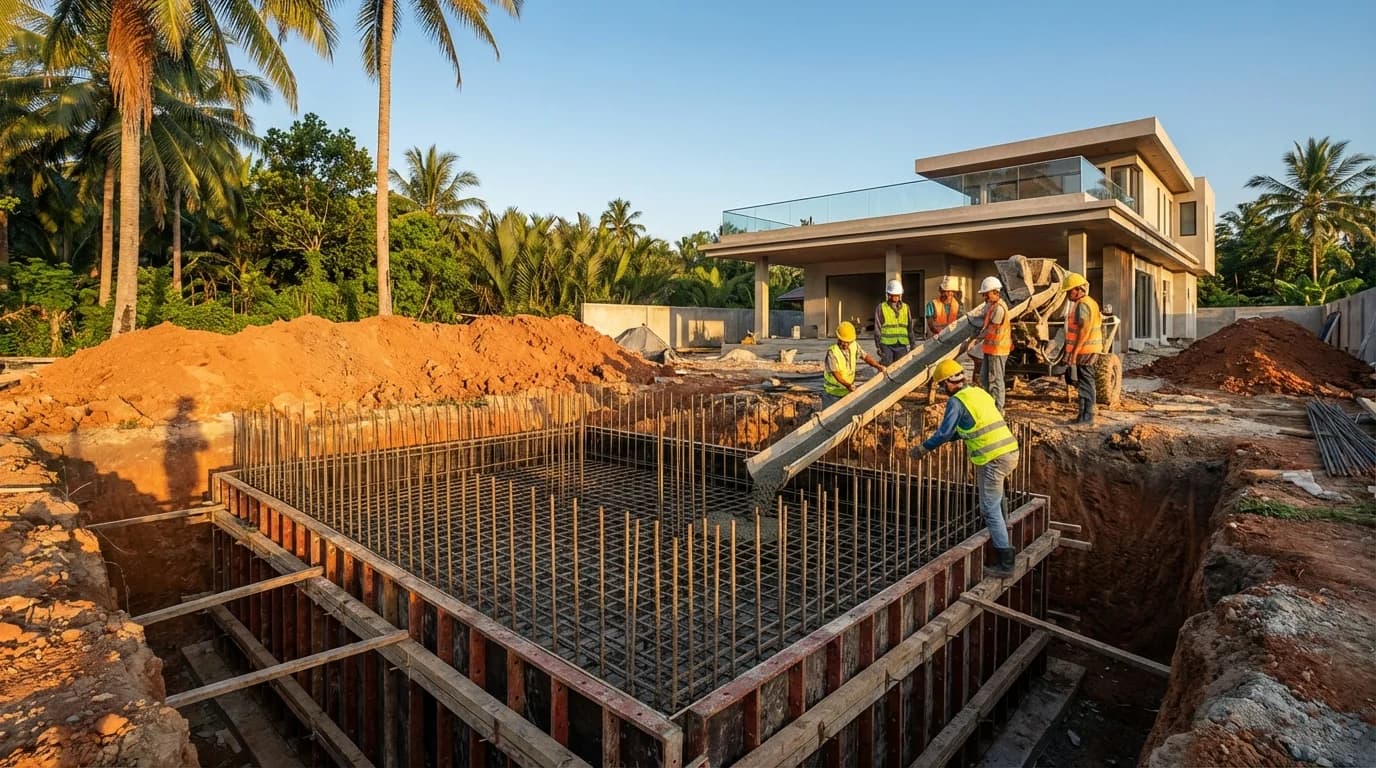
A high-quality septic tank uses poured concrete with rebar reinforcement. The tank is formed, reinforced, and poured as a monolithic structure. No joints, no blocks, no seams. Water stays inside the tank until it exits through the designed outlet. The result is a tank that holds up longer, leaks less, and handles the load from multi-bathroom villas without degrading.
On Siargao, where the soil is porous coral limestone and the water table sits high, leaking matters more than it would on the mainland.
| Standard (CHB) | High-Quality (Poured) | |
|---|---|---|
| Cost | ₱55,000 | ₱85,000 |
| Material | Concrete hollow blocks | Poured concrete + rebar |
| Leak resistance | Low (mortar joints crack) | High (monolithic pour) |
| Lifespan | 10-15 years | 20-30 years |
| Handles high water table | Poorly | Well |
| Good for 4+ bedrooms | No | Yes |
| Good for rental villas | No | Yes |
| Maintenance | Pump every 2-3 years | Pump every 3-5 years |
The cost difference between these two systems is ₱30,000. On a villa build that runs ₱5-9 million total, that's less than 0.5% of your budget. For rental properties generating ₱3,000-₱8,000 per night, you recover that difference in less than a week of bookings.
Why Septic Choice Matters More on Siargao
Most of mainland Philippines can tolerate a basic CHB septic tank without obvious problems. Siargao is different for three reasons.
Porous Coral Substrate
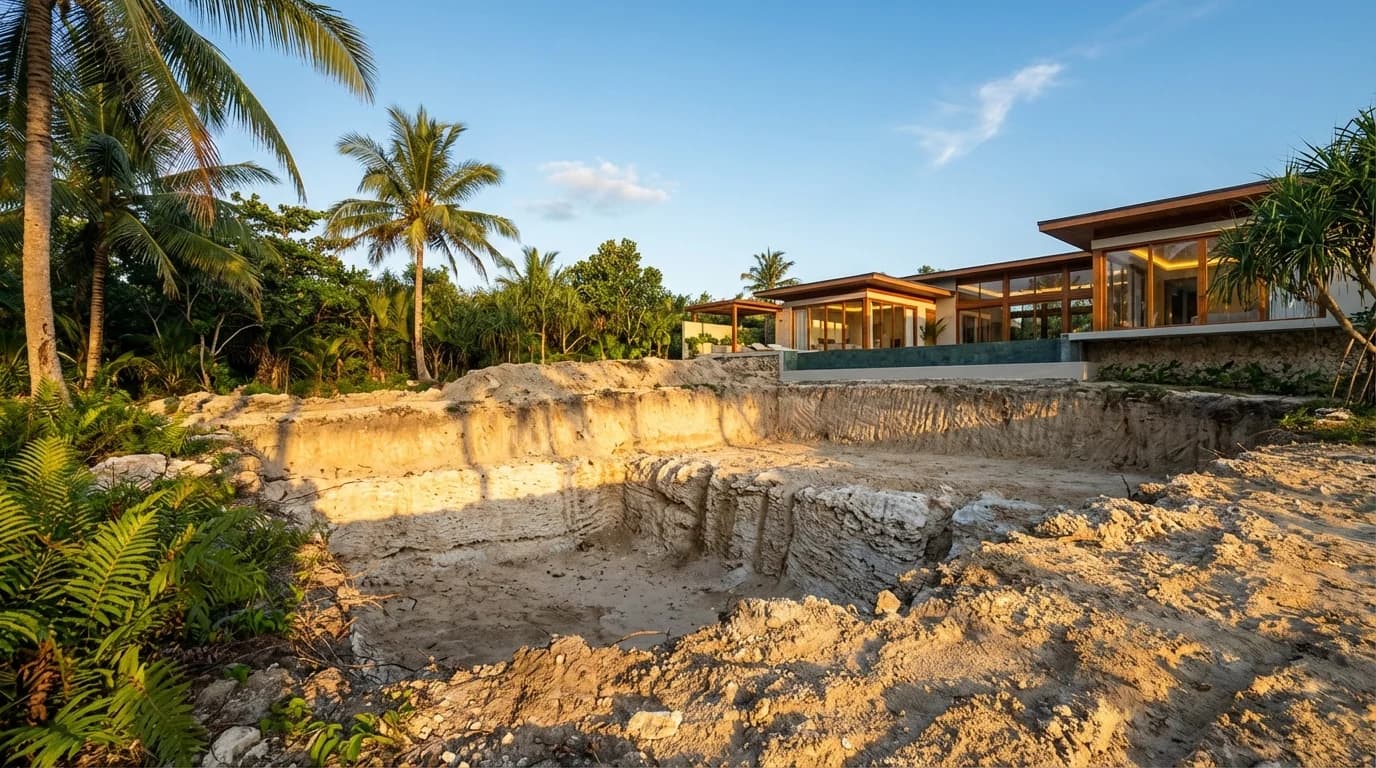
Siargao sits on raised coral limestone. Unlike clay or loam soils that filter water slowly, coral rock is riddled with cracks and channels. Water moves through it fast and with almost no filtration. If your CHB tank starts leaking (and it will, eventually), that waste travels quickly and spreads far through the coral substrate.
A poured concrete tank keeps everything contained. You're not relying on the surrounding ground to compensate for a leaking tank wall.
High Water Table
The water table sits close to the surface in coastal areas like General Luna, Cloud 9, and Pacifico. During rainy season (November through March), groundwater can rise to within a meter of the surface in low-lying lots.
When groundwater is high, any leak from a CHB tank mixes directly with the water table. That same groundwater feeds the deep wells that supply drinking water to neighboring properties. A solid poured concrete tank eliminates this risk at the source.
Proximity to Ocean and Reef
Cloud 9's reef break is one of the most famous surf spots in Asia. The mangrove systems along the coast support the local fishing industry. Both are directly downstream of whatever your septic system releases into the ground.
DENR and the local government unit (LGU) in General Luna have become increasingly strict about wastewater management. Building with a high-quality system now means you won't face problems later if enforcement tightens further.
Permit Requirements
You need two permits related to wastewater before construction starts: an environmental clearance and a sanitary permit. Both are required regardless of which septic system you choose.
Environmental Clearance: ₱10,000
The environmental clearance comes from the DENR (Department of Environment and Natural Resources) office. It costs ₱10,000 as a fixed fee. This permit confirms that your project meets environmental compliance standards, including wastewater management.
Siargao is part of the Siargao Protected Landscape and Seascape (SIPLAS), and the municipal government has been tightening enforcement on builds that threaten water quality. Choosing a poured concrete system makes this permit process smoother.
Sanitary Permit: ₱5,000 Base + ₱30/sqm
The sanitary permit covers your plumbing, drainage, and septic system design. It has a base cost of ₱5,000 plus ₱30 per square meter of floor area, capped at ₱10,000.
Here's how that scales:
| Floor Area | Calculation | Total |
|---|---|---|
| 80 sqm (small villa) | ₱5,000 + (80 x ₱30) = ₱7,400 | ₱7,400 |
| 120 sqm (mid-size) | ₱5,000 + (120 x ₱30) = ₱8,600 | ₱8,600 |
| 167+ sqm (hits cap) | ₱5,000 + (167 x ₱30) = ₱10,010 | ₱10,000 (cap) |
Any villa over 167 sqm hits the ₱10,000 maximum. Most rental villas on Siargao fall in the 100-150 sqm range, so expect to pay ₱8,000-₱9,500 for the sanitary permit.
Total Permit Costs for Wastewater
| Item | Cost |
|---|---|
| Environmental clearance | ₱10,000 |
| Sanitary permit (120 sqm example) | ₱8,600 |
| Permit total | ₱18,600 |
These permits apply to both tank types. They're separate from the system cost itself, so budget accordingly. See our full building permits breakdown for the complete permit picture.
Our Recommendation
Not every build needs the same system. Here's how to decide.
Go high-quality poured concrete (₱85,000) if:
- You're building a rental villa (Airbnb, long-term, or resort)
- Your lot is near the coast or in an area with high water table
- You're building 4+ bedrooms with multiple bathrooms
- You want the tank to last 20+ years without repairs
- You want hassle-free DENR environmental clearance
This covers the majority of villa builds on Siargao. If you're building in General Luna, Cloud 9, Tourism Road, or any coastal barangay, poured concrete is the right call.
Standard CHB (₱55,000) works if:
- Your lot is well inland with good drainage and deep groundwater
- It's a small personal build (1-2 bedrooms, low occupancy)
- Budget is extremely tight and every ₱30,000 counts
- You're building on elevated ground away from the water table
Even in these cases, keep in mind that the ₱30,000 upgrade is less than 0.5% of a typical villa budget. It's a small price for a system that won't crack and leak five years down the road.
Full System Budget
| Component | Standard Path | High-Quality Path |
|---|---|---|
| Septic system | ₱55,000 | ₱85,000 |
| Environmental clearance | ₱10,000 | ₱10,000 |
| Sanitary permit (120 sqm) | ₱8,600 | ₱8,600 |
| Total | ₱73,600 | ₱103,600 |
Our cost calculator includes both septic options and factors in environmental clearance and sanitary permit fees automatically. Plug in your villa specs to see how wastewater fits into your total build budget.
For more on infrastructure decisions, check out our guides on deep well and water costs and villa construction costs.
