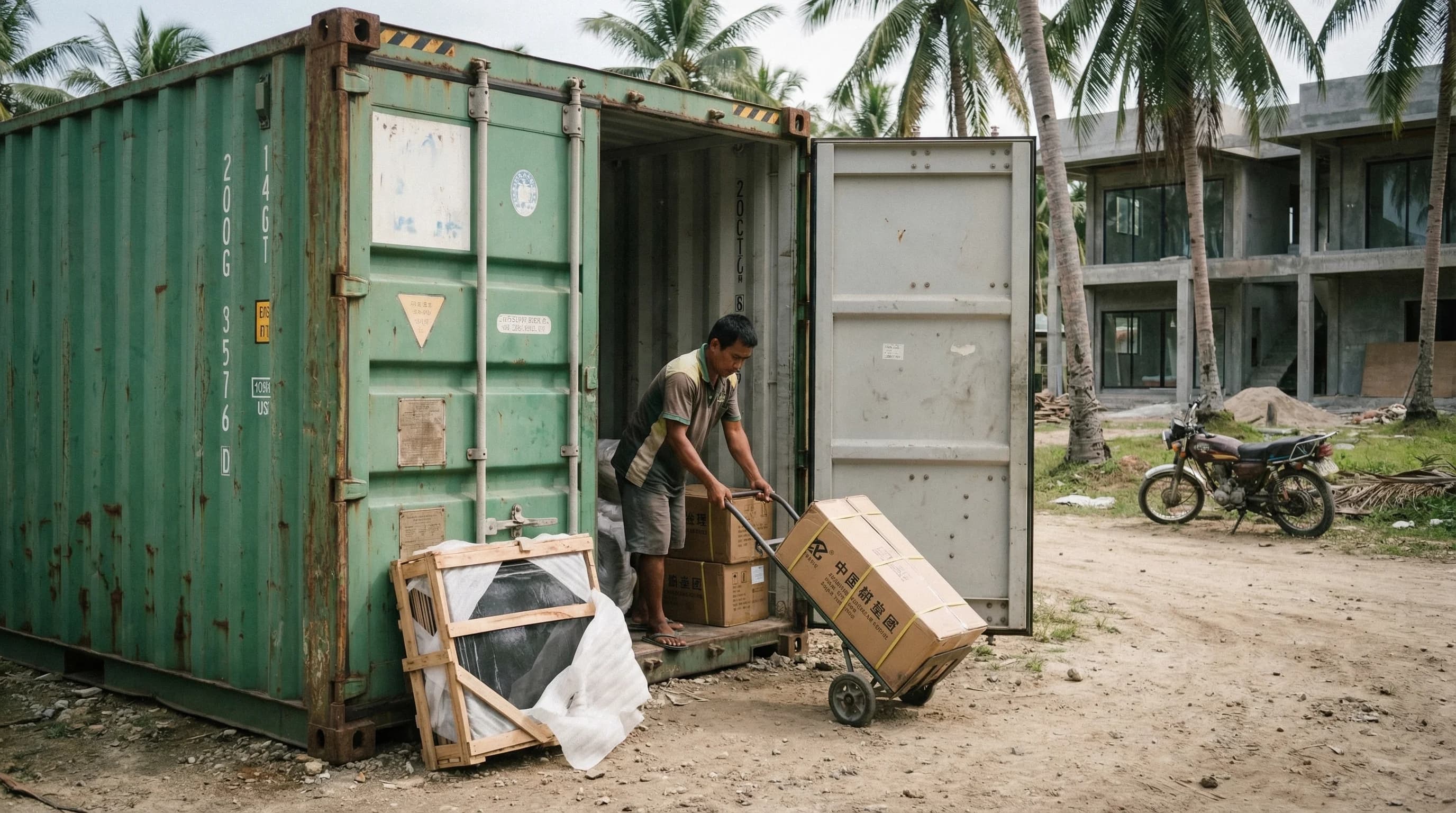
Most builders on Siargao don't realize you can ship tiles, fixtures, and full kitchen systems from Guangzhou for ₱7,000 to ₱8,000 per cubic meter, all-in. That flat rate covers ocean freight, customs clearance, import duties, taxes, and delivery to Surigao City. It's the kind of number that changes how you plan a build.
Why Builders Source from Guangzhou
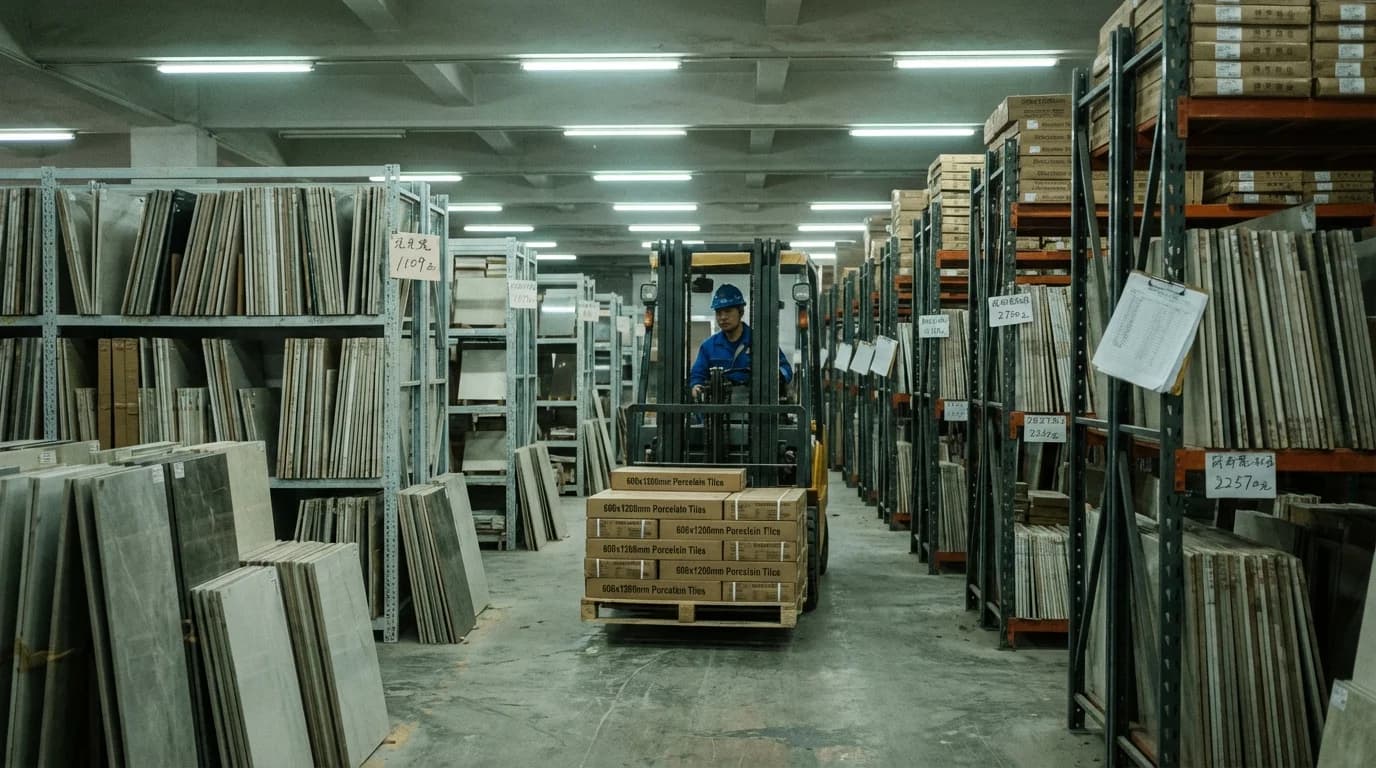
The math is simple. Large format porcelain tiles that retail for ₱1,200-2,000 per square meter in Cebu or Manila go for ₱300-500 at the factory gate in Guangzhou. Kitchen cabinet systems, bathroom vanities, shower enclosures, aluminum window frames, AC split units, even decorative stone panels: all of it costs 40-70% less at the source.
For a Mid-Range or High-End villa (₱45,000-65,000/sqm construction rate on Siargao), finishes and fixtures represent a big chunk of your per-sqm cost. Sourcing from Guangzhou lets you install premium-looking materials at a fraction of Philippine retail.
The items that make the biggest difference:
- Large format tiles and porcelain (600x600, 600x1200, 800x800)
- Kitchen cabinet systems (pre-cut, flat-packed)
- Bathroom vanities and shower enclosures (glass, stone, ceramic)
- Aluminum window and door systems (powder-coated, custom sizes)
- AC split units (Midea, Gree, other factory-direct brands)
- ACP cladding (aluminum composite panels for facades)
- Decorative stone and lighting fixtures
The quality you get from Guangzhou factories is genuinely good. These are the same factories supplying international hotel chains across Southeast Asia. You're not getting knockoffs. You're getting the same product without three layers of distribution markup.
What the Flat Rate Covers
China-to-Philippines freight forwarders operate on a flat-rate model. You won't get a line-item breakdown of customs duties, import taxes, brokerage fees, and ocean freight. Instead, you get a single per-cbm price that covers everything from the factory loading dock to the port of Surigao City.
Here's what's bundled into that ₱7,000-8,000/cbm rate:
| Component | Included |
|---|---|
| Factory pickup/loading | Yes |
| Ocean freight (Guangzhou to PH) | Yes |
| Customs clearance | Yes |
| Import duties and taxes | Yes |
| Brokerage and documentation | Yes |
| Delivery to Surigao City | Yes |
| Ferry to Siargao (Dapa port) | Typically extra |
| Last-mile to build site | Typically extra |
The exact breakdown of customs versus duty versus tax isn't something forwarders make transparent, and honestly, it doesn't matter to you as the builder. The all-in rate is the number that goes into your budget. Forwarders absorb the complexity and give you a flat number because that's what the market expects.
Container Math: From cbm Price to Container Cost
A standard 20-foot shipping container has roughly 33 cubic meters of usable interior space. A 40-foot container doubles that to about 67 cbm. The freight rate applies per cubic meter of cargo you ship.
Here's what the numbers look like:
| Container Size | Volume Capacity | Cost at ₱7,000/cbm | Cost at ₱8,000/cbm |
|---|---|---|---|
| 20ft | ~33 cbm | ₱231,000 | ₱264,000 |
| 40ft | ~67 cbm | ₱469,000 | ₱536,000 |
For a 100 sqm villa, you might need 200-300 sqm of tiles alone (walls and floors), plus cabinets and fixtures. Depending on how thick and heavy the materials are, that's roughly 10-20 cbm of cargo. A single 20ft container can handle most mid-range villa finishing packages.
Full container vs. groupage (LCL)
If you don't have enough material to fill a full container, forwarders offer LCL (less than container load), sometimes called groupage. Your goods share container space with other shipments. The per-cbm rate stays roughly the same, but you lose control over timing. Your shipment waits until the container fills up, which can add 2-4 weeks.
If you're shipping more than 10 cbm of product, a full 20ft container usually makes more sense. You control the schedule, and there's less risk of damage from other people's cargo shifting during transit.
What to Import from China (and What Not To)
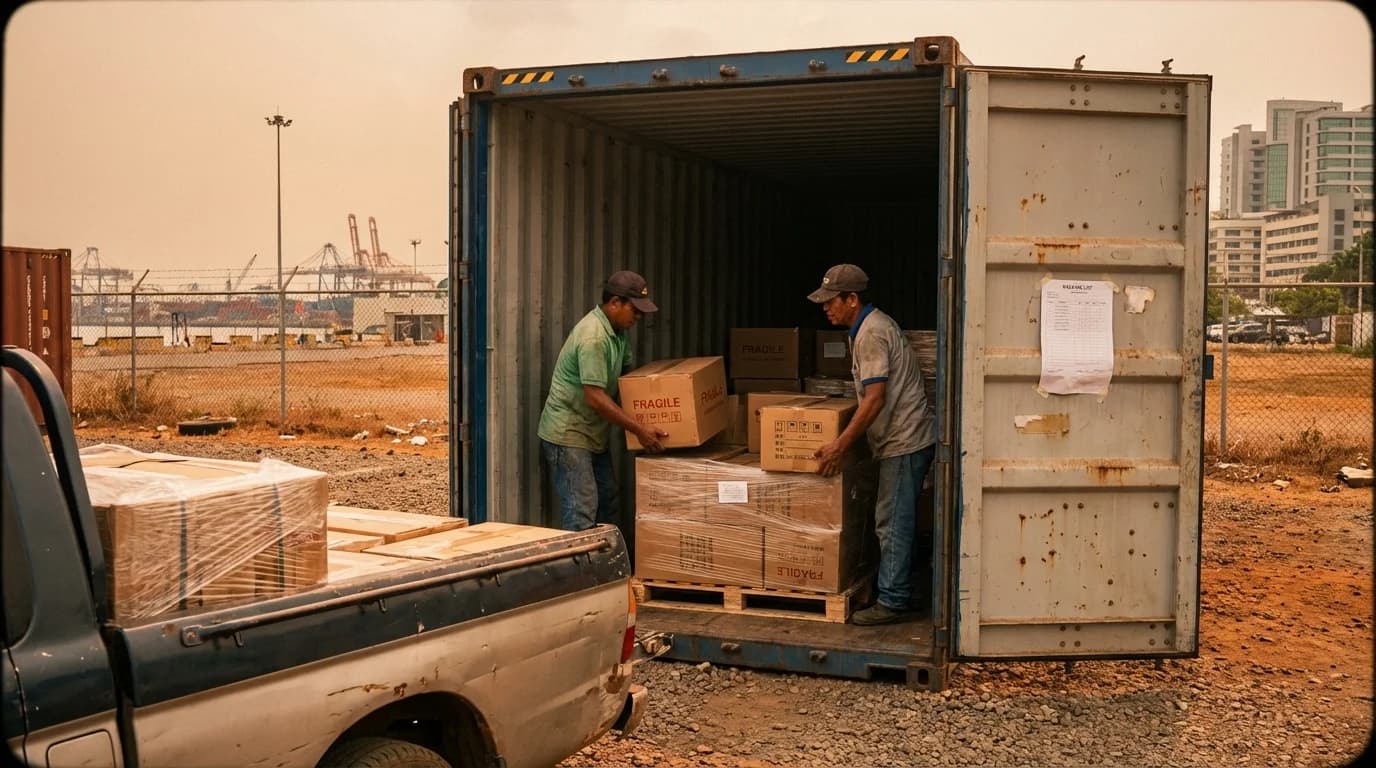
Not everything makes sense to ship across the South China Sea. The rule is straightforward: import things that are expensive here but cheap there, and leave the heavy/cheap stuff to local suppliers in Surigao.
| Import from China | Source Locally |
|---|---|
| Large format tiles | Cement |
| Porcelain/ceramic finishes | Rebar/steel |
| Kitchen cabinet systems | Sand and gravel |
| Bathroom vanities | Hollow blocks |
| Shower enclosures (glass) | Lumber |
| Aluminum windows/doors | Roofing sheets |
| AC split units | Plumbing pipe (PVC) |
| Decorative stone panels | Electrical wire |
| Lighting fixtures | Concrete mix |
| ACP cladding | Paint |
The local materials column is all stuff that's heavy relative to its value. Shipping cement or rebar from Guangzhou would cost more in freight than buying it in Surigao City. Hollow blocks weigh a ton and cost almost nothing locally. Sand and gravel don't even need the ferry, some builders source aggregate right on Siargao.
The China column is the opposite: high value per kilo, significant price gap versus Philippine retail, and easy to pack in a container without excessive weight.
The Logistics Chain: Factory to Build Site
Here's the full journey your materials take from a Guangzhou factory floor to your construction site in General Luna, Cloud 9, or wherever you're building:
1. Factory in Guangzhou (Week 0) Your order gets manufactured, quality-checked, and packed. Factory lead time varies: tiles can ship in days from stock, custom kitchen cabinets take 2-3 weeks to fabricate.
2. Guangzhou port (Week 1-2) The forwarder consolidates your goods, handles export documentation, and loads the container onto a vessel.
3. Ocean freight to Manila or Cebu (Week 2-4) Transit takes 2-3 weeks depending on the route and whether it's a direct sailing or has stops. Most Siargao-bound freight goes through Manila or Cebu.
4. Customs clearance (Week 4-5) Your forwarder handles this. Import duties, taxes, and documentation. This step can take a few days to two weeks depending on volume at the port.
5. Transshipment to Surigao City (Week 5-6) Domestic shipping from Manila or Cebu to Surigao. Your goods typically arrive at Surigao's port by inter-island cargo.
6. Ferry to Siargao (Week 6-7) Materials cross from Surigao City to Dapa port on the regular cargo ferry. This leg is weather-dependent. During rough seas (amihan season, November through March), ferries can be delayed by days.
7. Last mile to build site (Week 7-8) From Dapa, a truck (or multiple habal-habal trips for smaller loads) gets everything to your lot. If your site is on an unpaved road, plan for dry season delivery or risk materials getting stuck.
Total: 6 to 8 weeks, factory to site.
Timing Your Order
This is where most first-time builders get it wrong. They start construction, get the slab poured, and then think about ordering tiles from China. By the time the shipment arrives 8 weeks later, the tiling crew has been sitting idle for a month. That's wasted labor cost and a delayed timeline.
The fix is simple. Order your China freight before you break ground. Here's a practical timeline:
| Milestone | Action |
|---|---|
| Design finalized | Select all finishes, fixtures, sizes |
| 2 weeks before groundbreaking | Place factory orders |
| Groundbreaking | Shipment in transit |
| Foundation + framing complete | Shipment arrives Surigao |
| Ready for finishes | Materials on site |
If you're building a Standard tier villa (₱36,000/sqm) and construction takes 4-6 months, your China freight should arrive around month 2-3, right when you transition from structural work to finishes.
Finding a Freight Forwarder
The China-to-Philippines freight market is well established. Hundreds of forwarders specialize in this route, and the flat-rate pricing model is standard. You won't be inventing anything new here. That said, not all forwarders are equal.
What to look for:
- PH-China specialists. Not general logistics companies. You want someone who runs this route weekly and knows the Surigao/Mindanao delivery leg.
- Flat-rate per-cbm quotes. This is the market standard. If someone quotes you per-item or per-kilo without a clear per-cbm conversion, that's a yellow flag.
- Itemized packing list requirement. Good forwarders will ask you for a detailed list of what you're shipping. They need it for customs declarations. If they don't ask, they're cutting corners.
- References from other builders. Ask in Siargao expat groups. Builders who've done this before will tell you exactly who they used and whether the shipment arrived intact.
Red flags:
- Per-item pricing that doesn't translate to a clear cbm rate
- Quoted rate excludes customs or taxes (then it's not really flat-rate)
- No physical presence or contact person in Guangzhou
- Can't provide tracking once the container ships
Most forwarders have Facebook pages or WeChat accounts. Communication is usually straightforward. Many have Filipino staff in Guangzhou who handle the coordination.
What This Means for Your Build Budget
Let's put it in context. If you're building a 120 sqm High-End villa at ₱65,000/sqm, your total construction budget is ₱7,800,000. Finishes and fixtures might account for 25-30% of that, so roughly ₱2,000,000-2,300,000 in materials.
By sourcing those materials from Guangzhou (including freight at ₱7,000-8,000/cbm), you could cut that materials line by 30-50%. That's ₱600,000 to ₱1,150,000 in savings, enough to upgrade your solar system, add a pool (see pool costs), or simply keep more cash for contingency.
The catch? It requires planning. You can't impulse-buy from China the way you can drive to a tile shop in Surigao. You need final designs locked, exact quantities counted, and an 8-week runway before you need materials on site. For builders who plan ahead, the savings are real.
Run your numbers through our cost calculator to see how imported finishes affect your total build cost. And if you haven't mapped out the other hidden costs of building on Siargao, start there. Freight is just one piece of the budget puzzle.
