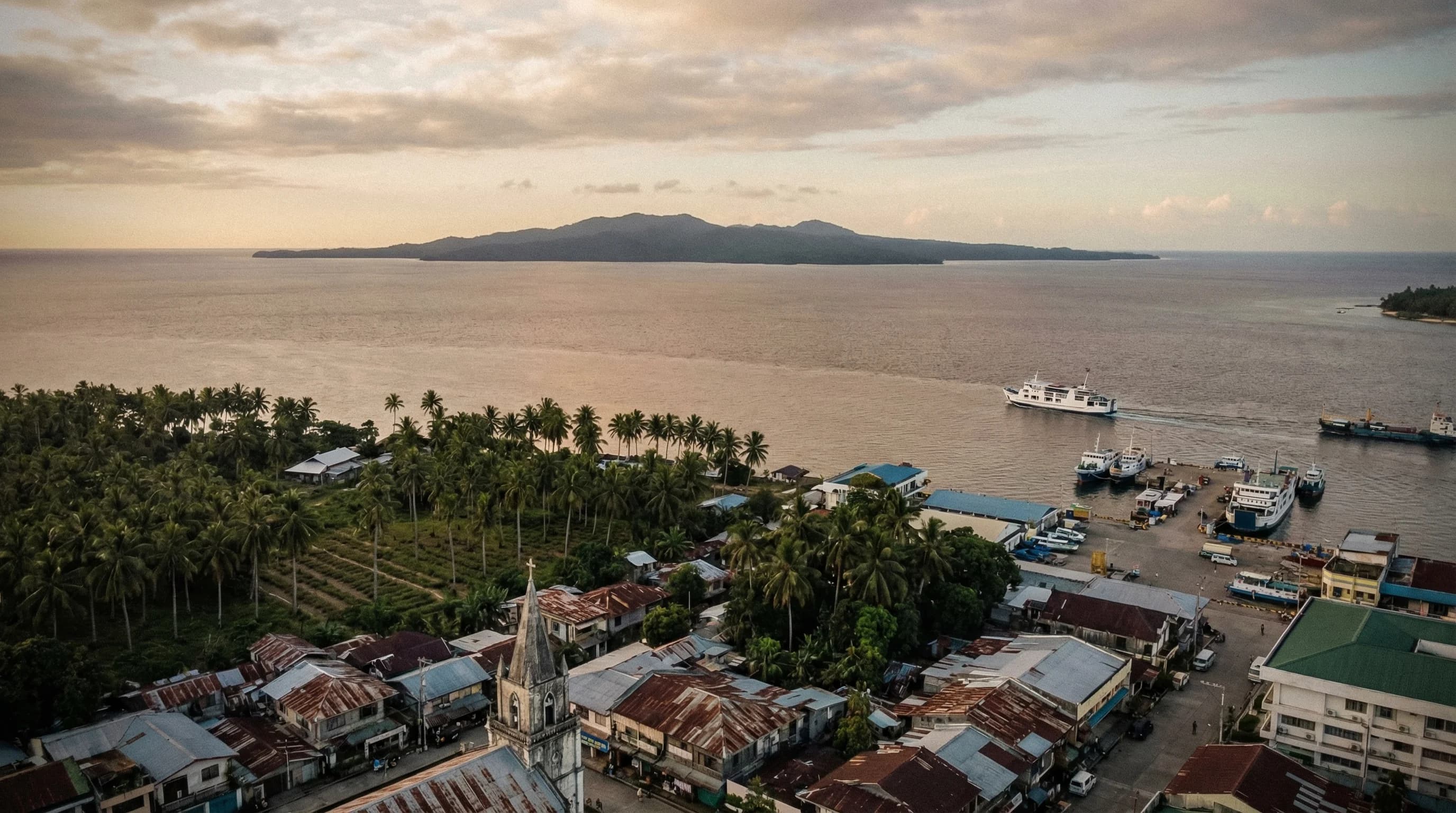
Surigao del Norte is one province, but it's really two construction markets. On the mainland, centered around Surigao City, you can build a solid residential structure for ₱15,000 to ₱35,000 per square meter. Hop on a ferry to Siargao island, and you're looking at ₱18,000 to ₱65,000/sqm for the same quality tiers. That gap comes down to one thing: logistics. Every bag of cement, every steel bar, every tile that reaches Siargao passes through Surigao City first.
If you're planning to build anywhere in this province, you need to understand how the mainland and island markets connect, where materials flow, and which local government units (LGUs) control your permits.
Surigao del Norte at a Glance
Surigao del Norte sits at the northeastern tip of Mindanao, part of the Caraga administrative region (Region XIII). The provincial capital is Surigao City, a port city with a population of roughly 170,000 that serves as the gateway to the Siargao island group.
The province's economy runs on three pillars: mining (nickel and chromite in the eastern municipalities), fishing, and tourism. Tourism has exploded over the past decade, driven almost entirely by Siargao's surf culture and the Cloud 9 break that put the island on the international map.
Geographically, the province includes the mainland strip along the coast, the Siargao island group (Siargao, Bucas Grande, and smaller islands), and the Dinagat Islands, which were carved into their own province in 2006 but still share infrastructure ties.
For builders, the key takeaway is this: Surigao del Norte is not a single market. The mainland has different costs, different contractors, different timelines, and different LGU requirements than the islands. The only thing they share is the Registry of Deeds office, which sits in Surigao City for the entire province.
Where to Build in the Province
Surigao City (Mainland)
Surigao City is where most provincial services are concentrated. The port, the airport, the registry offices, major hardware stores, and the regional hospital are all here. Construction here follows standard mainland Philippine patterns: contractors are plentiful, materials are available from local suppliers, and labor rates are lower than on the islands.
Most residential construction in the city targets OFW families and retirees. You won't find the villa-for-rent model that drives Siargao builds. Land prices are significantly lower, typically ₱3,000 to ₱8,000/sqm depending on proximity to the city center.
Siargao Island Group
This is where the investment action is. Siargao's eight buildable areas span a range from ₱2,000/sqm (Dapa) to ₱25,000/sqm (Cloud 9 prime lots). The island's construction market is tourism-driven, with most new builds designed as vacation rental villas.
Land prices on Siargao by location (2026 market data):
| Location | Min (₱/sqm) | Avg (₱/sqm) | Max (₱/sqm) |
|---|---|---|---|
| Cloud 9 | 12,000 | 18,000 | 25,000 |
| General Luna | 8,000 | 12,000 | 15,000 |
| Tourism Road | 5,000 | 8,500 | 12,000 |
| Santa Fe | 4,500 | 7,000 | 9,500 |
| Libertad | 4,000 | 6,500 | 9,500 |
| Pacifico | 3,000 | 5,500 | 8,000 |
| Tawin-Tawin | 3,000 | 5,000 | 7,000 |
| Dapa | 2,000 | 3,500 | 5,000 |
For a detailed breakdown of each area, see our guide to the best area to build on Siargao.
Other Municipalities
Placer, Claver, and Mainit are mainland municipalities with mining industry ties. Construction here is mostly residential housing for mining workers and their families. Costs are lower than Surigao City (₱12,000 to ₱25,000/sqm), but the rental market is virtually nonexistent for tourism. Unless you have a specific reason to build in these areas, they're not on most foreign investors' radar.
Construction Costs: Mainland vs Island
Here's where the numbers get interesting. The same construction quality tier costs meaningfully more on Siargao than on the mainland, and the premium increases with quality level.
| Quality Tier | Surigao City (₱/sqm) | Siargao Island (₱/sqm) | Island Premium |
|---|---|---|---|
| Basic / Cottage | 15,000-18,000 | 18,000 | +15-20% |
| Standard | 28,000-32,000 | 36,000 | +15-25% |
| Mid-Range | 35,000-40,000 | 45,000 | +15-20% |
| High-End | 45,000-55,000 | 65,000 | +20-25% |
The island premium comes from three sources:
Shipping costs. Every material that isn't locally sourced (which is most of them) travels by ferry from Surigao City. A RORO ferry crossing takes 2-3 hours and adds per-item freight charges. Heavy materials like cement, steel, and tiles are hit hardest.
Limited labor pool. Siargao has fewer skilled workers than the mainland. During peak building season (January through May), competition for experienced carpenters, electricians, and tile setters drives daily rates up. Some builders bring crews from the mainland, but that means housing and feeding them, which adds to the total.
Supplier markup. Hardware stores on Siargao carry smaller inventories and charge higher margins than mainland suppliers. A bag of Portland cement that costs ₱260-280 in Surigao City might run ₱320-350 on the island.
The Supply Chain: How Materials Move
Understanding the supply chain explains most of the cost differences in this province.
Manila and Cebu are the origin points for most construction materials: steel, premium tiles, plumbing fixtures, electrical components, and specialty items like solar panels. These arrive in Surigao City by cargo ship, typically on a 2-4 day transit schedule.
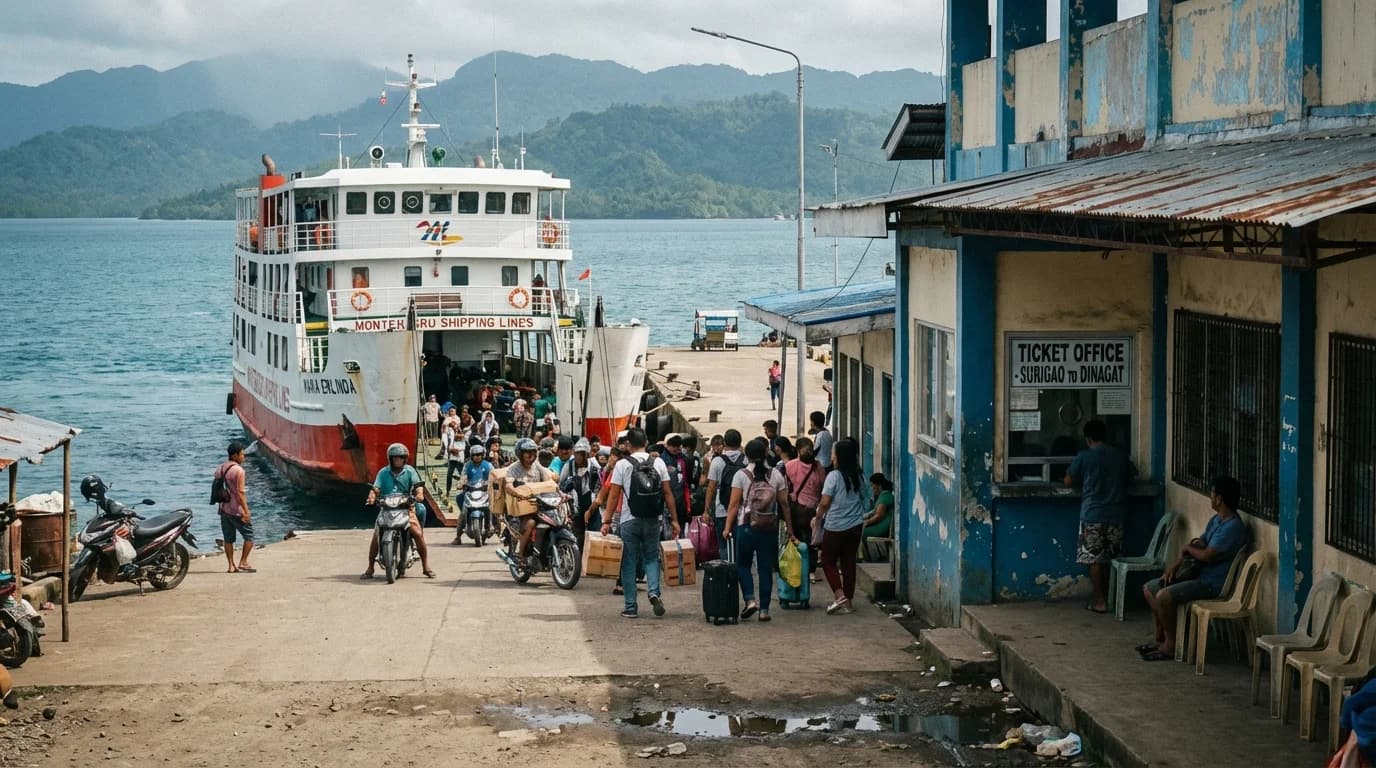
Surigao City port is the bottleneck and distribution hub. Materials are offloaded here, stored at hardware suppliers or staging yards, then reloaded onto RORO ferries or cargo boats bound for Siargao. The port handles multiple daily sailings to Dapa, Siargao's port town.
Dapa port receives everything destined for Siargao. From Dapa, materials travel by truck or multicab to build sites across the island. General Luna is about 45 minutes from Dapa. Cloud 9 is another 10 minutes beyond that. Remote locations like Pacifico add another hour.
Butuan (capital of Agusan del Norte, about 3 hours southwest of Surigao City) serves as a secondary hub. It has larger hardware chains and sometimes better prices for bulk orders. Some builders route materials through Butuan when Surigao City suppliers are out of stock.
The practical implication: every step in this chain adds time and cost. A standard build on the mainland might source materials in 1-2 days. The same order for a Siargao site can take 1-2 weeks if items aren't in stock locally.
Permits and LGU Structure
Surigao del Norte has a layered permit system that trips up first-time builders, especially on Siargao. The province contains multiple LGUs, each with its own building office, zoning rules, and processing timelines.
On Siargao island alone, you're dealing with four separate municipalities:
- Del Carmen (northern Siargao, includes mangrove areas)
- General Luna (eastern coast, covers GL town and Cloud 9)
- Santa Fe (northern tip, ferry terminal to Cebu/Leyte)
- Dapa (western side, main port, covers Dapa town and parts of interior)
Each municipality issues its own building permits, barangay clearances, and zoning approvals. A build in General Luna goes through the GL municipal engineering office. A build in Dapa goes through Dapa's office. The processes are similar but not identical, and processing times vary.
The one provincial-level step that applies to everyone: the Registry of Deeds in Surigao City. All land titles for Surigao del Norte are registered here. If you're buying land or setting up a lease, your lawyer or fixer will need to do title searches and registrations in the city, not on the island.
Standard permit costs on Siargao (from our building permits guide):
- Building permit: ₱30,000 base + ₱300/sqm (max ₱150,000)
- Electrical permit: ₱5,000 base + ₱50/sqm
- Sanitary/plumbing: ₱5,000 base + ₱30/sqm
- Barangay clearance: ₱1,500
- Zoning clearance: ₱3,500
- Environmental compliance: ₱10,000
For a 150 sqm villa, total permit costs typically land between ₱80,000 and ₱120,000.
Who Is Building in Surigao del Norte
Construction activity in the province breaks into four distinct groups:
Tourism investors on Siargao. This is the largest and fastest-growing segment. Foreign nationals (often through Filipino spouses or Philippine corporations) and Filipino-foreign partnerships building 1-4 bedroom villas for the Airbnb market. Construction quality ranges from standard to high-end, with budgets typically between ₱3 million and ₱20 million.
Mining sector housing. Concentrated in the eastern mainland municipalities (Claver, Placer), these are functional residential builds for mining company workers and their families. Basic to standard quality. Not relevant for most readers of this site, but it does affect contractor availability since some skilled workers split time between mining and tourism construction.
OFW and retiree homes. Overseas Filipino Workers sending money home for family residences, mainly on the mainland and in Dapa. These builds follow standard Philippine residential patterns: 80-150 sqm, standard quality, ₱2-5 million total.
Eco-resorts and boutique hotels. A smaller but growing category on Siargao. These are larger projects (₱20 million+) that require more complex permitting, including tourism accreditation and environmental compliance certificates. Most are concentrated in General Luna and along Tourism Road.
Why Siargao Is the Investment Sweet Spot
Within Surigao del Norte, Siargao captures the vast majority of foreign investment interest, and the numbers support that.
A 2-bedroom villa with a pool on Siargao generates ₱11,700 per night at market rates, with average occupancy around 71%. That translates to roughly ₱3 million in annual gross revenue. A 3-bedroom with pool pushes to ₱17,200 per night at 84% occupancy, crossing ₱5.2 million gross annually.
Even without a pool, a 2-bedroom villa pulls ₱4,265 per night at 61% occupancy, generating around ₱950,000 annually. These are real numbers from current Siargao rental data, not projections.
Land on the island has appreciated 15-25% annually in prime areas over the past three years. Cloud 9 lots that sold for ₱10,000/sqm in 2023 now list at ₱18,000/sqm average. Tourism Road, which barely registered as a location five years ago, now commands ₱8,500/sqm average.
The mainland, by contrast, doesn't offer this kind of return profile. Surigao City has no significant short-term rental market. Long-term residential rents are modest. Land appreciation tracks provincial averages of 5-8% annually. It's fine for a family home, but not for an investment play.
If you're looking at Surigao del Norte as a builder or investor, the island is where the math works. The mainland is the supply chain backbone that makes island construction possible, and understanding both sides gives you an edge over builders who only focus on the island.
Ready to see what your Siargao build would actually cost? Our calculator uses real 2026 construction rates, location-specific land prices, and current rental data to model your full project, from foundation to first guest booking.
For more on specific Siargao locations, check our area comparison guide. If you want to understand construction costs in detail, start with our villa construction cost breakdown. And for the full step-by-step process, read the complete building guide.
