
You found a perfect lot on Siargao. Beachfront, palm trees, five minutes from Cloud 9. You're ready to buy. Then someone tells you: foreigners cannot own land in the Philippines.
That's correct. But it doesn't mean you can't build here. Hundreds of foreigners have built villas on Siargao using legal structures that give them control of land without holding title in their own name. This guide covers the three main paths, what each one costs, and which one fits your situation.
Disclaimer: This is not legal advice. Always consult a Philippine attorney before entering any land transaction or corporate structure. Laws change, enforcement varies by municipality, and your specific situation may require a different approach than what's described here.
The Constitutional Rule
Article XII, Section 7 of the 1987 Philippine Constitution is clear: private land ownership in the Philippines is limited to Filipino citizens and corporations that are at least 60% Filipino-owned.
This isn't a regulation that could change with the next administration. It's written into the Constitution. Amending it would require a national plebiscite, and despite periodic political discussions about economic liberalization, no amendment has passed.
The restriction applies to land only. Foreigners can own the building or structure on the land. They can own condominium units (up to 40% of a condo project's total units). They can hold long-term leases. But the dirt underneath? That stays in Filipino hands.
This creates a gap between what foreigners want (security, control, long-term investment) and what the law allows. The three structures below are how people bridge that gap.

Option 1: Long-Term Lease
The most straightforward path. You lease land from a Filipino landowner for a fixed term, then build on it. The building is yours. The land stays in the owner's name.
How It Works
Under the Investors' Lease Act (Republic Act 7652), foreign investors can lease private land for up to 50 years, renewable once for 25 years. That gives you a maximum of 75 years of security.
Your lease gets registered with the Registry of Deeds and annotated on the land title. This is critical. An unregistered lease is just a private agreement with no protection against third-party claims. A registered lease shows up when anyone does a title search, which protects you if the landowner tries to sell the property.
What It Costs
Lease rates on Siargao vary by location. Here are annual rates per square meter:
| Location | Min (per sqm/yr) | Avg (per sqm/yr) | Max (per sqm/yr) | 500 sqm/year at Avg |
|---|---|---|---|---|
| Cloud 9 | ₱50 | ₱65 | ₱80 | ₱32,500 |
| General Luna | ₱40 | ₱55 | ₱70 | ₱27,500 |
| Tourism Road | ₱30 | ₱45 | ₱60 | ₱22,500 |
| Santa Fe | ₱25 | ₱40 | ₱55 | ₱20,000 |
| Pacifico | ₱20 | ₱35 | ₱50 | ₱17,500 |
| Libertad | ₱20 | ₱30 | ₱45 | ₱15,000 |
| Tawin-Tawin | ₱15 | ₱25 | ₱40 | ₱12,500 |
| Dapa | ₱10 | ₱20 | ₱30 | ₱10,000 |
A 500 sqm lot in General Luna at the average rate of ₱55/sqm/year costs ₱27,500 annually. Over the full 75-year maximum term, that's roughly ₱2,062,500 in total lease payments. Compare that to a purchase price of ₱6,000,000 for the same lot through a corporation, and the lease path is significantly cheaper in raw numbers.
Pros
- Simplest legal structure. No corporation to manage, no shareholders to coordinate with.
- Lowest upfront cost. You pay annual rent instead of a lump-sum land purchase plus ₱250,000 in corporation setup fees.
- Clear legal standing. Long-term leases for foreigners have explicit statutory backing.
- Building ownership. You own the structure outright, separate from the land.
Cons
- No equity in the land. Land values on Siargao have been rising 10-15% annually in prime areas. As a leaseholder, you don't benefit from that appreciation.
- Renewal risk. The 25-year renewal is not automatic. If the landowner (or their heirs) refuses, you could lose access when the initial term expires.
- Landowner dependency. You need a cooperative landowner for the full lease term. Death, family disputes, or financial problems on their side can create complications.
- Escalation clauses. Most leases include annual rate increases of 3-5%. Over 50 years, compounding turns a modest annual payment into a significant one.
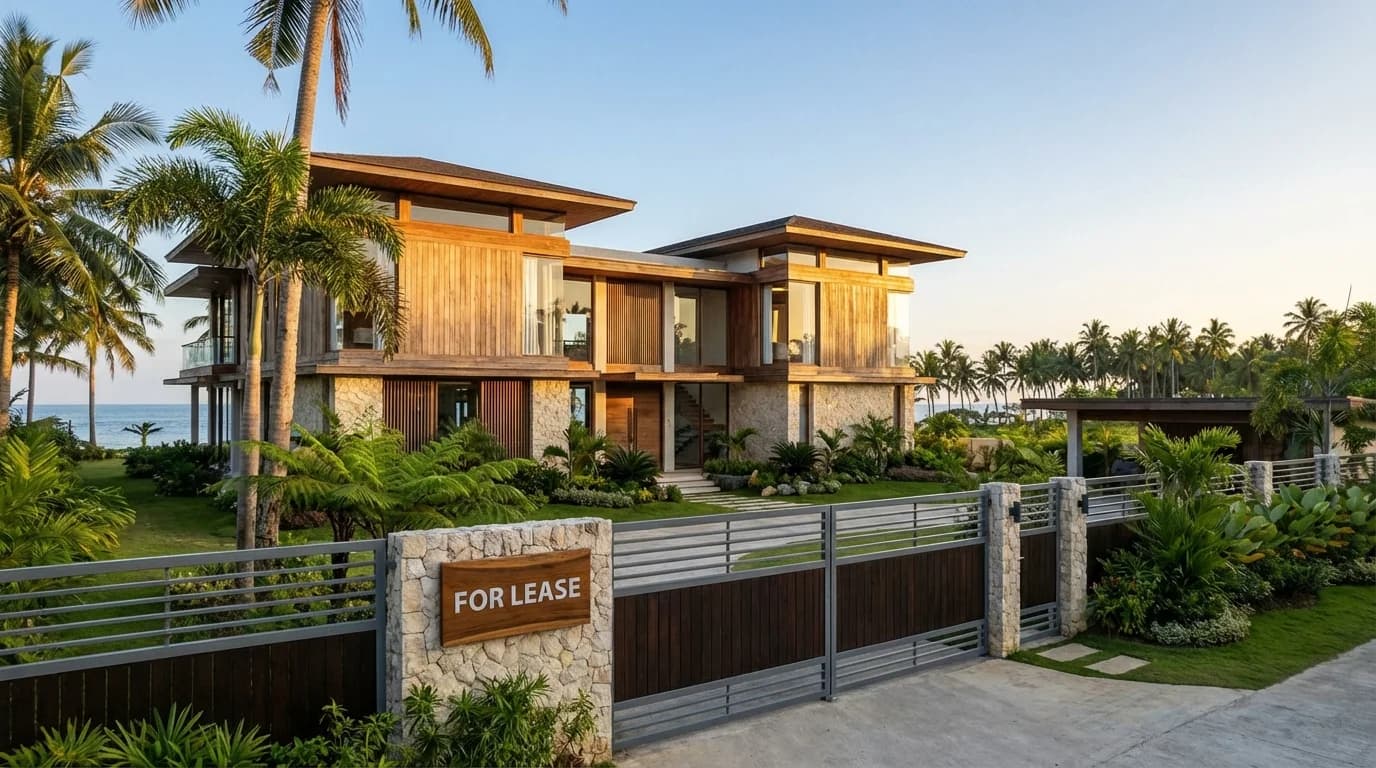
Option 2: Philippine Corporation (60/40 Rule)
This is the path for foreigners who want to purchase land outright (through a corporate entity) and build equity in the property over time.
How It Works
You incorporate a Philippine corporation where Filipino citizens hold at least 60% of shares and you (the foreigner) hold up to 40%. The corporation then purchases and holds title to the land.
Despite owning only 40% of shares, you can structure the corporation to give yourself significant operational control through shareholder agreements, board composition, and voting structures. This is where having a good lawyer matters most.
What It Costs
One-time setup: ₱250,000 for SEC registration, articles of incorporation, bylaws, initial compliance, and legal fees.
Annual compliance: ₱50,000 to ₱80,000 per year for accounting, annual reports, SEC filings, and tax returns. The corporation must file even if it has no active business operations.
Property tax: ₱25,000 per year as a baseline for a typical residential property. The actual amount depends on assessed value and local government rates.
Land tax rate: 7.5% of assessed value applies when purchasing land through the corporation.
Total first-year cost for a 500 sqm lot in General Luna (at ₱12,000/sqm average): ₱6,000,000 land purchase + ₱250,000 corporation setup + ₱450,000 land tax (7.5%) + ₱25,000 property tax + ₱60,000 compliance = roughly ₱6,785,000.
The Anti-Dummy Act
The Anti-Dummy Act of 1936 (Commonwealth Act No. 108) makes it illegal for a Filipino citizen to act as a nominee or dummy for a foreigner in activities reserved for Filipinos. If the SEC or any government agency determines that the Filipino shareholders are just names on paper with no real ownership interest, the corporation can be dissolved and the land forfeited.
This law is not theoretical. Prosecutions have happened, particularly in cases where the arrangement was poorly structured or the parties had a falling out.
To stay compliant:
- Filipino shareholders must have genuine capital contributions (not just borrowed from the foreign partner).
- Filipino shareholders should participate in actual corporate governance.
- Board meetings and corporate records need to be properly maintained.
- The 60/40 split must be real, not a paper arrangement.
Pros
- Land equity. The corporation owns the land, and as a 40% shareholder, you participate in value appreciation.
- Permanent structure. No lease term to worry about. The corporation exists until dissolved.
- Bank financing. A corporation with land title can access Philippine bank loans. Leaseholders generally cannot.
- Resale flexibility. Selling shares in a corporation is simpler than transferring a lease and building.
Cons
- Higher cost. ₱250,000 setup plus ₱50,000-80,000 annual compliance, on top of the land purchase price.
- Partner dependency. You need Filipino partners you trust with 60% of your corporation.
- Regulatory risk. The Anti-Dummy Act hangs over every 60/40 structure. A disgruntled partner can weaponize it.
- Ongoing overhead. Annual filings, tax returns, and accounting are required whether or not the corporation has revenue.
Option 3: Filipino Spouse
If you're married to a Filipino citizen, your spouse can own land outright. This is the simplest path on paper, but it comes with important caveats.
How It Works
Under the Family Code of the Philippines, property acquired during marriage is generally conjugal (jointly owned). Your Filipino spouse purchases the land in their name. If the marriage is under the default property regime (absolute community of property), both spouses have equal rights to conjugal assets.
However, if the marriage ends (annulment or legal separation), foreign spouses have no independent right to own the land. The land goes to the Filipino spouse or is sold, with proceeds divided according to the court's ruling.
Pros
- No corporate structure needed. No setup fees, no annual compliance.
- Full land ownership through your spouse.
- Lowest ongoing cost. Just the standard property tax of ₱25,000/year.
Cons
- Entirely dependent on the marriage. If the relationship ends, you may lose everything.
- No independent legal control. The title is in your spouse's name. Your rights exist only through the marriage.
- Inheritance complications. Philippine succession law is complex and may not distribute assets the way you expect.
Lease vs. Corporation: Side-by-Side
| Lease | Corporation | |
|---|---|---|
| Upfront cost | ₱0 (just first year rent) | ₱250,000 setup + land purchase |
| Annual cost (500 sqm GL) | ₱27,500 lease | ₱85,000 (compliance + property tax) |
| Land equity | None | 40% through corporation |
| Maximum term | 50 + 25 years (75 total) | Permanent |
| Legal complexity | Low | High |
| Partner needed | No (just landlord) | Yes (60% Filipino shareholders) |
| Anti-Dummy Act risk | None | Present |
| Building ownership | Yes (yours outright) | Yes (corporation-owned) |
| Bank financing | Difficult | Possible |
| Best for | Budgets under ₱10M, single properties | High-value land, multiple properties, long-term investors |
Which Should You Choose?
For most first-time foreign builders on Siargao, a long-term lease is the better starting point. Here's why:
If your total project budget is under ₱10,000,000, the ₱250,000 corporation setup cost plus annual compliance fees eat into your budget without providing proportional benefit. A lease in a mid-range location like Tourism Road costs ₱22,500 per year. That's negligible compared to your construction costs.
If you're building a single villa, the corporate overhead is hard to justify. A corporation makes more sense when you're holding multiple properties or land parcels, because the fixed compliance costs get spread across assets.
If this is your first project on Siargao, a lease gives you time to understand the local market, build relationships, and figure out whether you want to commit to a deeper legal structure. You can always incorporate later and transfer operations.
The corporation path makes sense when:
- You're purchasing high-value land (₱5,000,000+) where equity appreciation matters
- You plan to hold multiple properties or develop commercially
- You have a trusted Filipino business partner with a genuine stake
- You want the option of bank financing for construction
One more consideration: several foreigners on Siargao use a hybrid approach. They lease the land and own the building personally, but form a corporation for the rental business operations. This avoids the Anti-Dummy Act issues around land ownership while still giving them a corporate structure for business income, expenses, and tax planning.
Disclaimer
This article is for informational purposes only. This is not legal advice. Philippine property law is complex, and enforcement varies between municipalities and provinces. Laws, regulations, and interpretations change over time. Before making any real estate decisions, consult a licensed Philippine attorney who specializes in foreign investment and real property law. The costs and figures cited here are based on current market conditions and may not reflect your specific situation.
Next Steps
If you're still early in the process, our foreigner's guide to building on Siargao covers the full picture beyond just land ownership, including permits, construction, and operational setup.
For current land prices by location, see our Siargao land price guide with per-sqm rates across all eight tracked areas.
Ready to run the numbers on a specific lot and building plan? Our cost calculator factors in location-specific land costs, lease vs. purchase, construction, and projected rental income so you can compare scenarios before committing.
